Blood Transfusion Reactions for the NCLEX: Types, Signs and What the Nurse Does First
Last updated: October 30, 2026
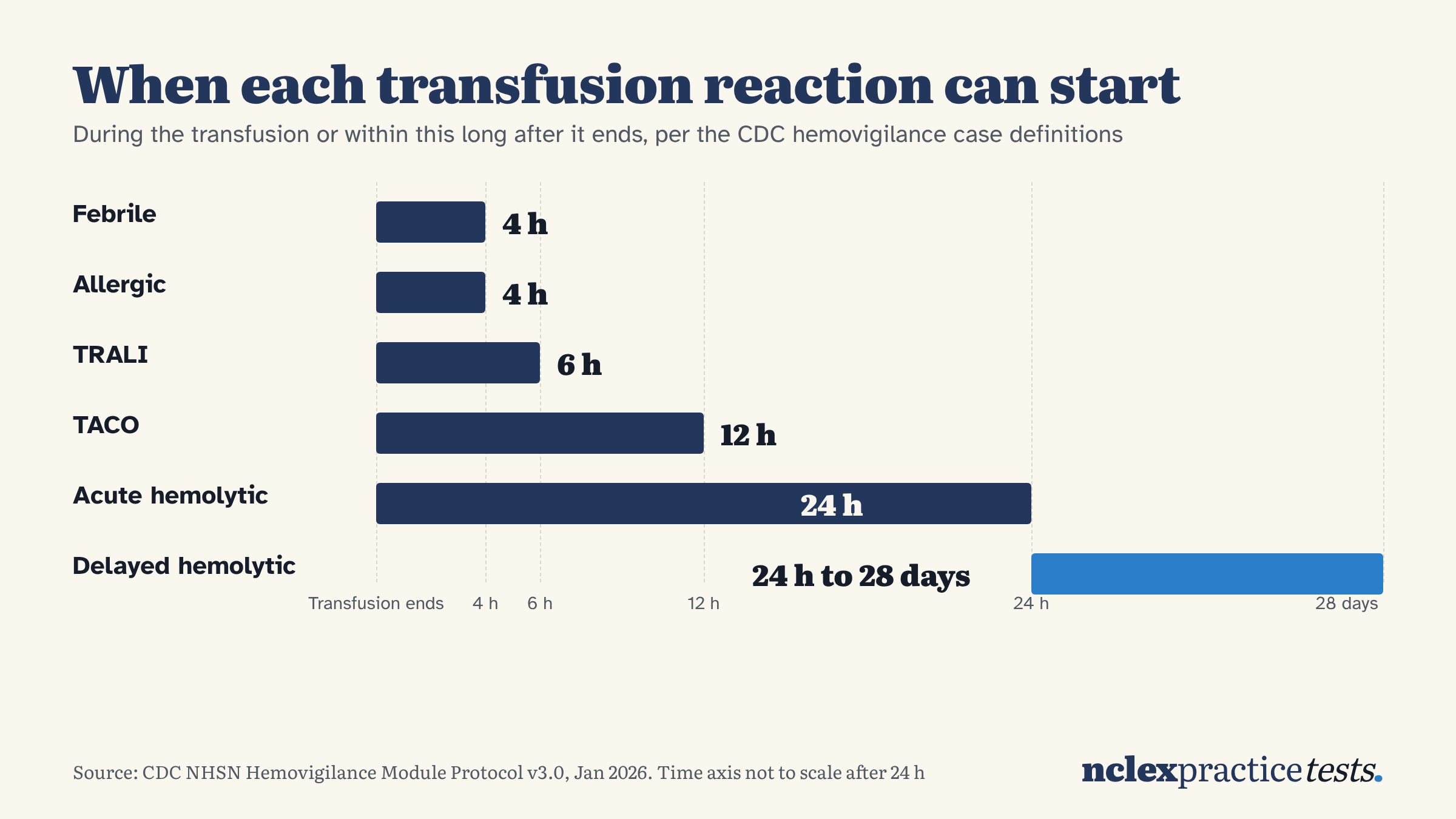
For any suspected blood transfusion reaction, the first action is the same: stop the transfusion, keep the vein open with 0.9% sodium chloride through new tubing, then notify the provider and the blood bank. Telling the reactions apart comes second, and three cues do most of the work: when it began, which way the blood pressure moved, and whether there is fever.
This guide puts the eight reactions the NCLEX tests in one table, with time windows from the CDC’s hemovigilance definitions. Then it works through three of our own questions, all on the free NCLEX pharmacology practice questions.
What does the nurse do first for any transfusion reaction?
Every new sign during a transfusion is treated as a reaction until proven otherwise. You do not need to name the reaction to take these steps. The New York State transfusion reaction fact sheets, written by the state’s Council on Human Blood and Transfusion Services with its Board for Nursing, list stopping the transfusion first for most acute reactions, and for every acute reaction except a mild allergic one they say to send the bag back and not to start another unit without the blood bank. The saline line and the bedside assessment are the standard nursing steps around them.
- Stop the transfusion. Do not slow it, and do not finish the unit.
- Keep the vein open with 0.9% sodium chloride through new tubing, so medicines and fluids can go in if the client worsens.
- Assess: vital signs, breathing, lung sounds, urine color. Stay with the client.
- Notify the provider and the blood bank.
- Send the bag and the tubing back to the blood bank, with the attached solutions and blood samples from the client. A new unit is not started without the blood bank’s advice.
Most “what should the nurse do first” items about blood come down to step 1. The wrong options usually keep blood running in some form. Our prioritization guide shows the same pattern in other topics: the action at the bedside comes before the phone call.
Stop, never slow. Slowing the rate helps prevent circulatory overload in a client at risk. Once a reaction has started, every option that keeps blood flowing is wrong.
The eight reactions side by side
The time windows are the CDC’s case definitions: the National Healthcare Safety Network (NHSN) Hemovigilance Module Protocol, version 3.0, January 2026. The blood pressure and fever cues come from the Canadian Blood Services Clinical Guide to Transfusion, chapter 10. The actions after the stop come from the New York State fact sheets.
| Reaction | When it starts | The cue that separates it | After stopping the blood |
|---|---|---|---|
| Acute hemolytic | During or within 24 hours | Fever, chills, back or flank pain, pain at the IV site, dark or red urine, low blood pressure | Fluids to protect the kidneys, watch urine output, support blood pressure |
| Febrile non-hemolytic | During or within 4 hours | Temperature at least 38°C (100.4°F) and up at least 1°C (1.8°F), or chills; no rash, no breathing problem | Acetaminophen as prescribed |
| Allergic, mild | During or within 4 hours | Hives, itching, flushing; vital signs stable, lungs clear | Antihistamine; the unit may restart if the blood bank agrees |
| Anaphylaxis | Usually during or soon after | Wheezing, throat tightness, swelling, low blood pressure, no fever | Airway and oxygen, epinephrine, fluids |
| TACO (circulatory overload) | During or within 12 hours | Dyspnea, crackles, distended neck veins, blood pressure up | Sit upright, oxygen, diuretic as prescribed |
| TRALI (lung injury) | During or within 6 hours | Sudden hypoxia, bilateral infiltrates, blood pressure may fall, may have fever | Oxygen and breathing support; diuretics not helpful |
| Septic (bacterial) | No set window in the CDC or Canadian definitions | High fever (often a rise over 2°C), rigors, low blood pressure; platelets most often | Cultures of the client and the unit, antibiotics |
| Delayed hemolytic | 24 hours to 28 days later | Jaundice, dark urine, a hemoglobin that falls without bleeding | Notify the provider; blood bank tests for a new antibody |
The windows for febrile, allergic and delayed hemolytic reactions are from the protocol’s section on previously used classifications, which CDC keeps available for facilities. Neither the CDC protocol nor the Canadian guide sets a window for septic reactions, so the table gives its signs and treatment from the New York fact sheet.
Acute hemolytic reaction: the one to fear
An acute hemolytic reaction happens when the client’s antibodies destroy the donor red cells, usually because of an ABO mismatch. The Canadian Blood Services guide calls clerical errors “a significant contributor” to ABO-incompatible transfusions. The New York fact sheet says they often come from wrong patient identification, either when the type and screen sample is drawn or when the blood is hung.
The CDC definition lists back or flank pain, chills, fever, blood in the urine, low blood pressure, low urine output, and pain or oozing at the IV site. It can lead to kidney failure and disseminated intravascular coagulation.
That is why the bedside check matters. Our item on Exam 1 asks which check is required before a unit starts, and the answer is two clinicians matching the blood label to the client’s identification band at the bedside. A room number is never an identifier.
Once the unit is matched, the first 15 minutes are when a severe reaction most often shows. Practice Exam 7 tests that step inside a case: a client with an upper GI bleed whose first unit of red cells has just arrived.
Febrile and allergic reactions: the common ones
A febrile non-hemolytic reaction is a temperature of at least 38°C (100.4°F) that has risen at least 1°C (1.8°F), or chills, within 4 hours, per the CDC definition. The Canadian Blood Services guide puts it at about 0.33% of red cell transfusions and 4.6% of platelet transfusions. Treatment is supportive, often acetaminophen. The same guide notes that giving acetaminophen and diphenhydramine beforehand does not prevent it.
A mild allergic reaction is hives, itching or flushing with normal vital signs. It is the only reaction where restarting the same unit is on the table. Per the New York fact sheet, after an antihistamine the unit may be restarted if it can be finished within 4 hours of being opened. It is not restarted if the hives are severe or there is swelling, a breathing or stomach problem, or low blood pressure. Those signs move it toward anaphylaxis, which the Canadian guide estimates at 1 in 50,000 red cell transfusions.
Worked question: hives at 20 minutes
This select-all item is on Exam 4.
Twenty minutes after a unit of packed red blood cells is started, a client reports itching and has raised welts on the chest and arms. Temperature, blood pressure, heart rate, and respiratory rate are unchanged from baseline, and the lungs are clear. Which actions should the nurse take? Select all that apply.
- A. Keep the IV line open with 0.9% sodium chloride
- B. Stop the transfusion
- C. Give epinephrine intramuscularly right away
- D. Notify the provider and the blood bank
- E. Flush the blood tubing with 5% dextrose in water
- F. Give an antihistamine as prescribed
Answer: A, B, D and F. Hives with stable vital signs and clear lungs is a mild allergic reaction. It still starts with stopping the blood, keeping the line open with saline and reporting it, then an antihistamine. Epinephrine is for anaphylaxis, with wheezing, throat swelling or low blood pressure, and none of those is present. Dextrose is never hung with blood because it can make red cells clump and break apart.
TACO or TRALI? Read the blood pressure
Both cause sudden shortness of breath and fluid in the lungs during or soon after a transfusion. The CDC definitions give TACO up to 12 hours and TRALI up to 6. The table in the Canadian Blood Services guide separates them like this.
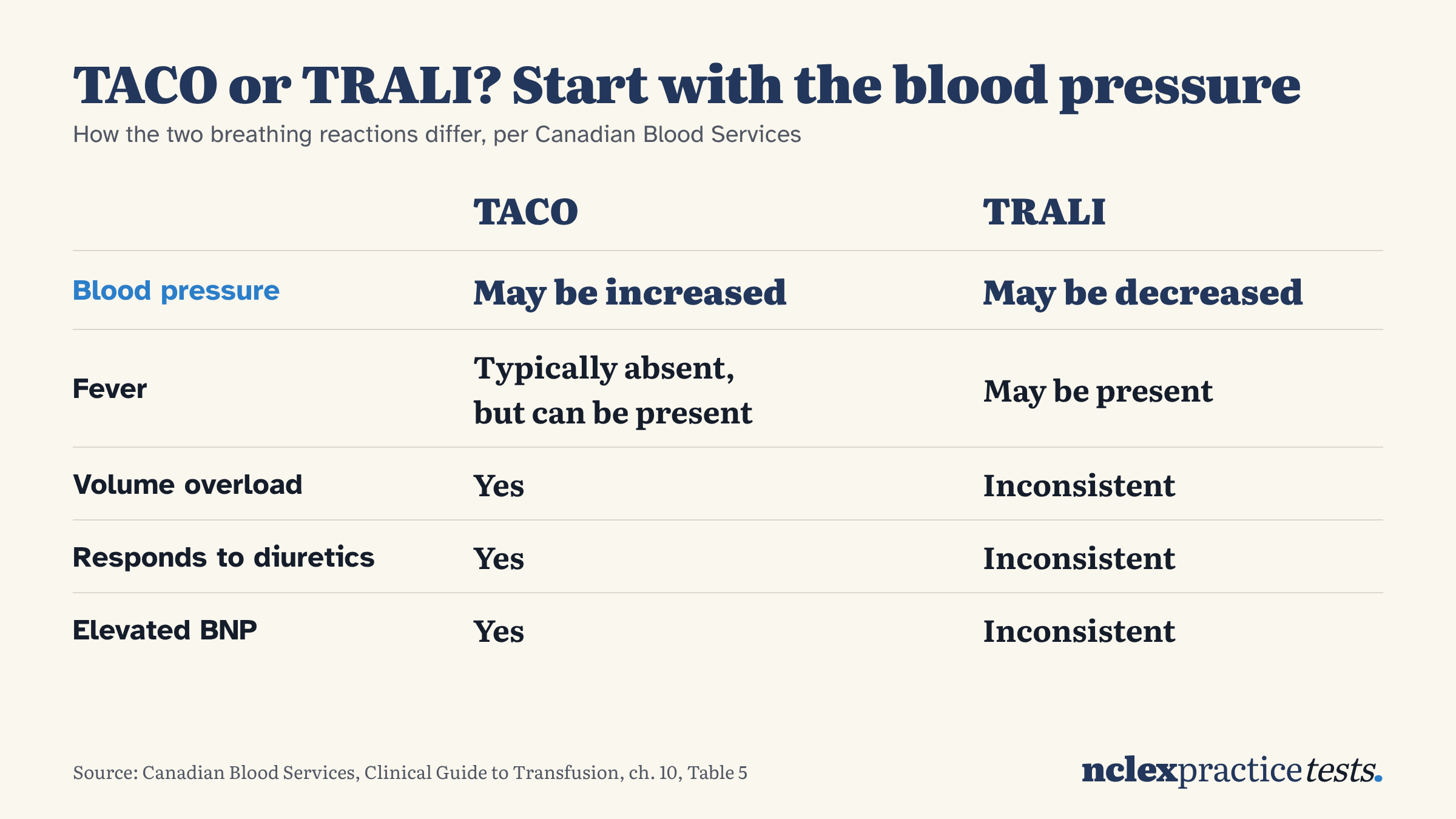
| Feature | TACO | TRALI |
|---|---|---|
| Onset (CDC) | Within 12 hours | Within 6 hours |
| Blood pressure | May be increased | May be decreased |
| Fever | Typically absent, but can be present | May be present |
| Volume overload | Yes | Inconsistent |
| Responds to diuretics | Yes | Inconsistent |
| Elevated BNP | Yes | Inconsistent |
The client at risk for TACO is the NCLEX favorite: an infant or an older adult, heart failure, kidney failure, a fast rate. The New York fact sheet treats it with a stop, an upright position, oxygen and a diuretic. For TRALI, the same source says diuretics and steroids are generally not helpful and may be contraindicated. Most clients with TRALI improve over 2 to 3 days.
Worked question: short of breath on the second unit
This item is on Exam 4.
An 84-year-old client with heart failure is receiving a second unit of packed red blood cells. Ninety minutes into the unit, the client becomes short of breath and wants to sit up. Blood pressure is 172/94 (134/78 before the transfusion), heart rate 112, respiratory rate 28, oxygen saturation 89% on room air, and temperature 37.1°C. There are crackles in both lung bases and the neck veins are distended. What should the nurse do first?
- A. Continue the unit and ask the provider for a diuretic to give with the rest of it
- B. Slow the transfusion to half the rate and recheck the vital signs in 15 minutes
- C. Give the prescribed diphenhydramine and keep the transfusion running
- D. Stop the transfusion, keep the client upright, and apply oxygen
Answer: D. A rising blood pressure, crackles, distended neck veins and no fever in an older client with heart failure is TACO. Stopping the unit removes the cause, and sitting up with oxygen treats the hypoxia. A diuretic is likely next, but not while more volume runs in. Slowing still adds volume to wet lungs. Diphenhydramine treats hives, not fluid.
The trap in TACO items is "slow the rate." A slow rate prevents overload in a client at risk. Once crackles and hypoxia appear, the unit is stopped.
Septic reaction: fever, rigors and falling pressure
Bacterial contamination is rare. The Canadian Blood Services guide estimates septic reactions to platelets at about 1 in 100,000, and platelets are the usual source because they are stored at room temperature. The New York fact sheet lists a high fever, often a rise of more than 2°C (4°F), chills, rigors, low blood pressure and shock.
After the stop, the unit goes to the lab for a Gram stain and culture, blood cultures are drawn from the client, and IV antibiotics follow. On an exam, a high fever with rigors and a falling blood pressure during a platelet transfusion points here.
Delayed hemolytic reaction: the one that shows up later
A delayed hemolytic reaction appears after the client has gone home. The CDC window runs from 24 hours to 28 days. The New York fact sheet says it typically occurs 3 to 7 days after, and the Canadian guide gives a median of 1 to 2 weeks. The signs are jaundice, a low-grade fever, dark urine and a hemoglobin that falls without bleeding.
Our pharmacology questions include a client 8 days after 2 units, with yellow sclerae and a hemoglobin down from 10.4 to 8.1 g/dL. Circulatory overload, a febrile reaction and hepatitis B are the distractors. Only a delayed hemolytic reaction explains a falling hemoglobin and jaundice a week later.
What our transfusion questions test
Our bank has 133 original items across the practice pages. Five are about transfusion, and all five are on the pharmacology practice questions. Four are about a reaction. Three of those ask what to do, and all three key “stop the transfusion.” The fourth asks which reaction it is.
The two single-answer “what first” items have six wrong options between them. Five of the six keep blood running: finish the unit, slow it, continue it with a diuretic, or give diphenhydramine and keep it going. The sixth throws away the bag. That is the whole trap set, and the rule above answers all of it.
Worked question: fever and back pain at 15 minutes
This item opens Exam 3.
A transfusion of packed red blood cells was started 15 minutes ago. The client now has hives, a new backache, and a temperature of 38.9°C. What should the nurse do first?
- A. Stop the transfusion and keep the vein open with normal saline through new tubing
- B. Finish the unit because the client is already halfway through it
- C. Disconnect the blood and discard the bag and tubing
- D. Slow the rate and give the rest of the unit
Answer: A. The cues are mixed: hives fit an allergic reaction, while fever and new back pain early in a unit raise concern for hemolysis. You do not have to decide which to answer it. Stop first, keep the line open with saline, stay with the client, then notify. The bag and tubing go back to the blood bank, so C destroys the evidence. B and D keep giving the blood that may be causing the harm.
Practice next
Take the five transfusion items in Study mode on the pharmacology practice questions, then sit Exam 4 timed, where two of them sit among 28 items on other topics. For the drugs in the same test plan category as blood products, such as heparin, warfarin and IV potassium, see the NCLEX pharmacology cheat sheet. Every item is original and written to the NCSBN test plan categories, as described on how questions are written. This is exam preparation, not clinical guidance: follow your facility’s transfusion policy at the bedside. The CDC, Canadian Blood Services and New York State documents behind this guide are listed on sources, and more guides are on the study guide.
Frequently asked questions
What is the first thing a nurse does for a suspected transfusion reaction?
Stop the transfusion. Then keep the IV access open with 0.9% sodium chloride through new tubing, assess the client, and notify the provider and the blood bank. The bag and tubing go back to the blood bank for testing, so they are not thrown away.
What is the most common transfusion reaction?
Febrile non-hemolytic and mild allergic reactions are the common ones. The Canadian Blood Services Clinical Guide to Transfusion puts febrile reactions at about 0.33% of red cell transfusions and 4.6% of platelet transfusions. Acute hemolytic reactions are rare but can be fatal.
How do you tell TACO from TRALI?
Both cause sudden shortness of breath and fluid in the lungs. In TACO the blood pressure tends to rise and the client improves with a diuretic. In TRALI the blood pressure may fall, fever may be present, and diuretics do not reliably help.
Can a transfusion be restarted after a reaction?
Only after a mild allergic reaction with hives or itching alone, once it is treated and the blood bank and provider agree. New York State's transfusion fact sheets add that the unit must be finished within 4 hours of being opened. Any other reaction means the unit is not restarted.
Why is only normal saline used with blood?
Dextrose solutions can make red cells clump and break apart, and other fluids can cause hemolysis. That is why 0.9% sodium chloride is the only solution hung with blood and the one used to keep the line open after a reaction.
Built and maintained by the NCLEX Practice Tests team. Items are original and checked against the published test-plan categories before they go up. Each rationale is reviewed before publish. These are study questions, not official NCSBN items and not medical advice. About this site →