NCLEX Pharmacology Cheat Sheet: Drug Suffixes, Key Nursing Actions and Lethal Mix-Ups
Last updated: November 20, 2026
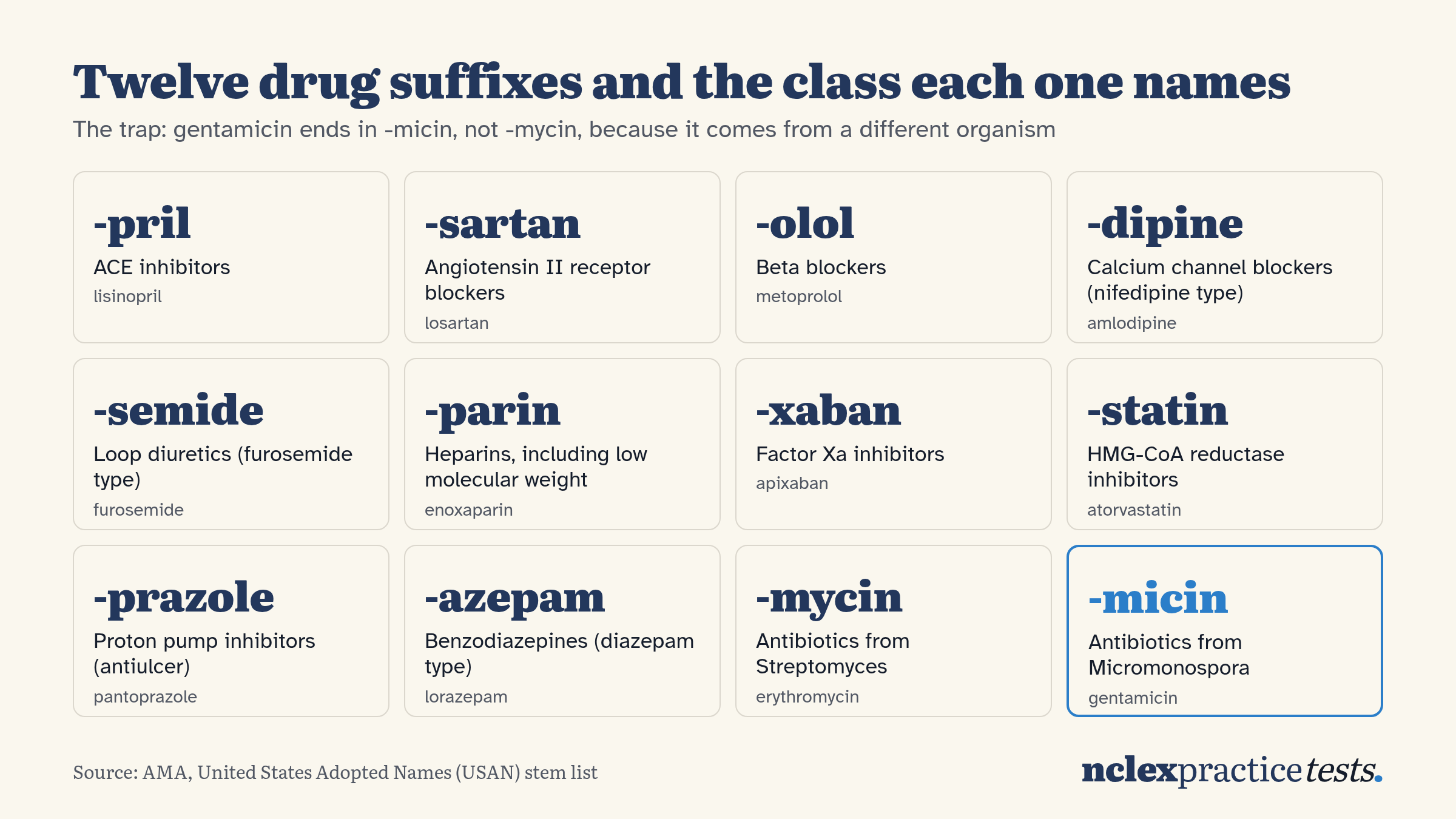
A drug’s suffix tells you its class, and the class tells you what to check before you give it. Every suffix below is checked against the official USAN stem list, and every warning sign and antidote against the drug’s FDA prescribing information.
But a suffix only gets you so far. Insulin, morphine, potassium chloride and magnesium sulfate carry no class suffix, and they are on the ISMP list of high-alert medications. In our own bank, 18 of 48 pharmacology questions are built on a high-alert drug, and 10 of those 18 turn on opioids, insulin, potassium or magnesium: drugs you learn by name, not by suffix.
Drug suffixes: what each stem means
The United States Adopted Names (USAN) Council assigns the generic names of US drugs and keeps a list of stems: name parts that mark a drug class. The definitions below are from that list. The “plain name” column is how a nursing textbook would say it.
| Stem | USAN definition | Plain name | Example |
|---|---|---|---|
| -pril | antihypertensives (ACE inhibitors) | ACE inhibitor | lisinopril |
| -sartan | angiotensin II receptor antagonists | ARB | losartan |
| -olol | beta-blockers (propranolol type) | beta blocker | metoprolol |
| -alol | combined alpha and beta blockers | alpha and beta blocker | labetalol |
| -dipine | phenylpyridine vasodilators (nifedipine type) | calcium channel blocker | amlodipine |
| -semide | diuretics (furosemide type) | loop diuretic | furosemide |
| -thiazide | diuretics (thiazide derivatives) | thiazide diuretic | hydrochlorothiazide |
| -renone | aldosterone antagonists (spironolactone type) | potassium-sparing diuretic | eplerenone |
| -statin | antihyperlipidemics (HMG-CoA inhibitors) | statin | atorvastatin |
| -parin | heparin derivatives and low molecular weight heparins | heparin, LMWH | enoxaparin |
| -farin | warfarin analogs | vitamin K antagonist | warfarin |
| -xaban | antithrombotics, factor Xa inhibitors | factor Xa inhibitor | apixaban, rivaroxaban |
| -gatran | thrombin inhibitors (argatroban type) | direct thrombin inhibitor | dabigatran |
| -teplase | tissue-type plasminogen activators | thrombolytic | alteplase |
| -prazole | antiulcer agents (benzimidazole derivatives) | proton pump inhibitor | pantoprazole |
| -tidine | H2-receptor antagonists (cimetidine type) | H2 blocker | famotidine |
| -azepam | antianxiety agents (diazepam type) | benzodiazepine | lorazepam |
| -oxetine | antidepressants (fluoxetine type) | antidepressant (fluoxetine type) | fluoxetine |
| -cillin / cef- | penicillins / cephalosporins | beta-lactam antibiotics | amoxicillin / cefazolin |
| -mycin / -micin | antibiotics from Streptomyces / from Micromonospora | antibiotic | erythromycin / gentamicin |
| -oxacin | antibacterials (quinolone derivatives) | fluoroquinolone | ciprofloxacin |
| pred- | prednisone and prednisolone derivatives | corticosteroid | prednisone |
| -terol | bronchodilators (phenethylamine derivatives) | beta-2 agonist | albuterol |
| -setron | serotonin 5-HT3 receptor antagonists | antiemetic | ondansetron |
| -dronate | calcium metabolism regulators | bisphosphonate | alendronate |
| -gliflozin / -gliptin / -glutide | phlorizin derivatives / dipeptidyl aminopeptidase-IV inhibitors / glucagon-like peptide (GLP) analogs | SGLT2 inhibitor / DPP-4 inhibitor / GLP-1 agonist (diabetes drugs) | empagliflozin / sitagliptin / semaglutide |
Three traps sit in that table. Labetalol ends in -alol, not -olol, because it blocks alpha receptors too. Gentamicin ends in -micin because it comes from Micromonospora, not Streptomyces, so a “-mycin” rule will not catch it. And warfarin has its own stem, -farin, so the “-arin” shortcut some lists teach mixes up two different drugs with two different antidotes.
No suffix, no shortcut. Insulin, morphine, digoxin, lithium, potassium chloride and magnesium sulfate cannot be decoded from their names. Learn each one by name, with its check and its antidote.
Before you give it: the check, the warning sign, the antidote
This is the table to print. “Check first” is what the nurse looks at before the dose. “Stop and report” is the effect that changes the plan. The warning signs, boxed warnings and antidotes come from each drug’s FDA prescribing information on DailyMed. The checks are standard nursing assessments. Hold parameters, such as a pulse below which a dose is held, come from the provider’s order or the facility protocol, and the question usually gives them. When it does not, use the rule nursing textbooks teach for digoxin: hold it for an adult apical pulse below 60.
| Class (stem) | Check first | Stop and report | Antidote or reversal |
|---|---|---|---|
| ACE inhibitors (-pril) | Blood pressure, potassium | Swelling of the face, lips or tongue (angioedema); pregnancy | None; stop the drug |
| Beta blockers (-olol) | Apical pulse, blood pressure | Slow pulse below the ordered limit. Do not stop it abruptly: the label warns this can worsen myocardial ischemia | None specific |
| Loop diuretics (-semide) | Potassium, blood pressure, intake and output | Low potassium; ringing in the ears or hearing loss | None; replace potassium as ordered |
| Heparin (-parin) | aPTT (unfractionated heparin), platelets | Bleeding; a falling platelet count | Protamine sulfate |
| Enoxaparin (-parin) | Platelets, planned spinal or epidural procedures | Numbness or leg weakness after spinal or epidural anesthesia: a possible spinal hematoma (boxed warning) | Protamine sulfate |
| Warfarin (-farin) | INR | Bleeding; INR above the ordered range | Vitamin K (phytonadione) |
| Factor Xa inhibitors (-xaban) | Bleeding signs, planned procedures | Bleeding | Not vitamin K or protamine, per the rivaroxaban label |
| Dabigatran (-gatran) | Bleeding signs, planned procedures | Bleeding | Idarucizumab |
| Opioids (no class suffix) | Respiratory rate, sedation level | Slow breathing, a client who will not wake | Naloxone |
| Benzodiazepines (-azepam) | Sedation level, respiratory rate, other sedatives | Deep sedation; given with an opioid, the boxed warning lists respiratory depression, coma and death | Flumazenil |
| Digoxin (no class suffix) | Apical pulse for a full minute, potassium, digoxin level | Nausea, vomiting, yellow-green color vision. Low potassium or magnesium makes toxicity more likely | Digoxin immune fab |
| Insulin (no class suffix) | Blood glucose, timing of the meal | Low glucose: shaky, sweaty, confused | Fast carbohydrate if awake; glucagon or IV dextrose if not |
| Potassium chloride IV | Potassium level, urine output, dilution and pump | Never an IV push: the concentrate label says it must be diluted before use | None; stop the infusion |
| Magnesium sulfate IV | Respiratory rate, deep tendon reflexes, urine output | Lost reflexes, slow breathing. Reflexes fade above 4 mEq/L and may be absent near 10 mEq/L | IV calcium; the label says an injectable calcium salt should be immediately available |
| Lithium (no class suffix) | Lithium level, fluid and salt intake | Coarse tremor, vomiting, diarrhea. The boxed warning says toxicity can occur close to therapeutic levels | None; hold and report |
| Vancomycin (-mycin) | Kidney function, infusion time | Flushing and itching during the infusion. The label says to infuse over at least 60 minutes | None; stop or slow the infusion |
| Fluoroquinolones (-oxacin) | Age, steroid use, myasthenia gravis | Tendon pain, numbness or tingling, confusion (boxed warning) | None; stop the drug |
| Bisphosphonates (-dronate) | Can the client sit upright for 30 minutes | Heartburn or pain on swallowing | None |
| Acetaminophen (no class suffix) | Total daily dose from every product | Overdose, even without symptoms | Acetylcysteine |
Two administration rules come up again and again in teaching questions. Alendronate is taken with plain water at least 30 minutes before the first food, drink or other medicine of the day, and the client stays upright for at least 30 minutes and until after the first food of the day. Levothyroxine is taken on an empty stomach, half an hour to an hour before breakfast, with a full glass of water. Both rules are in the labels.
The antidote pairs in one list
- Heparin: protamine sulfate. Its label indication is “the treatment of heparin overdosage.”
- Warfarin: vitamin K (phytonadione), for prothrombin deficiency caused by coumarin anticoagulants.
- Dabigatran: idarucizumab, for emergency surgery or life-threatening bleeding.
- Opioids: naloxone.
- Benzodiazepines: flumazenil.
- Digoxin: digoxin immune fab.
- Acetaminophen: acetylcysteine, to prevent or lessen liver injury after an overdose.
- Magnesium sulfate: an IV calcium salt, such as calcium gluconate.
A high lab value is not always a reason for the antidote. On a heparin drip with an aPTT above target and no bleeding, the usual answer is to follow the protocol: hold for the stated time and restart lower. Protamine is for serious bleeding or a large overdose. Our heparin infusion question on Exam 7 tests exactly that line.
Lethal mix-ups: look-alike names and dangerous pairs
The Institute for Safe Medication Practices (ISMP) publishes a list of drug names that get confused, with “tall man” capitals to tell them apart. These pairs are on the ISMP tall man list:
| Name | Confused with | Why it matters |
|---|---|---|
| HYDROmorphone | morphine | Two opioids with very different strengths per milligram |
| hydrALAZINE | hydrOXYzine | An antihypertensive and an antihistamine |
| HumaLOG | HumuLIN | Rapid-acting insulin lispro and human insulin |
| cloNIDine | clonazePAM, cloZAPine | An antihypertensive, a benzodiazepine and an antipsychotic |
| predniSONE | prednisoLONE | Two closely related corticosteroids |
| glipiZIDE | glyBURIDE | Two sulfonylureas, both able to cause low glucose |
Dangerous pairs come from the labels themselves:
- Opioid plus benzodiazepine. The boxed warning on lorazepam names profound sedation, respiratory depression, coma and death.
- Loop diuretic plus digoxin. Furosemide lowers potassium, and the digoxin label lists low potassium as a cause of toxicity.
- ACE inhibitor plus potassium. The lisinopril label lists potassium-sparing diuretics, potassium supplements and salt substitutes as risk factors for high potassium.
- Furosemide plus an aminoglycoside such as gentamicin. The furosemide label links hearing damage to that combination.
The high-alert drugs, the ones where an error does the most harm, are on the ISMP list for acute care: anticoagulants and thrombolytics, insulin, opioids, concentrated potassium chloride, magnesium sulfate injection and IV oxytocin among them. The 2024 update added tranexamic acid injection.
What our pharmacology questions test
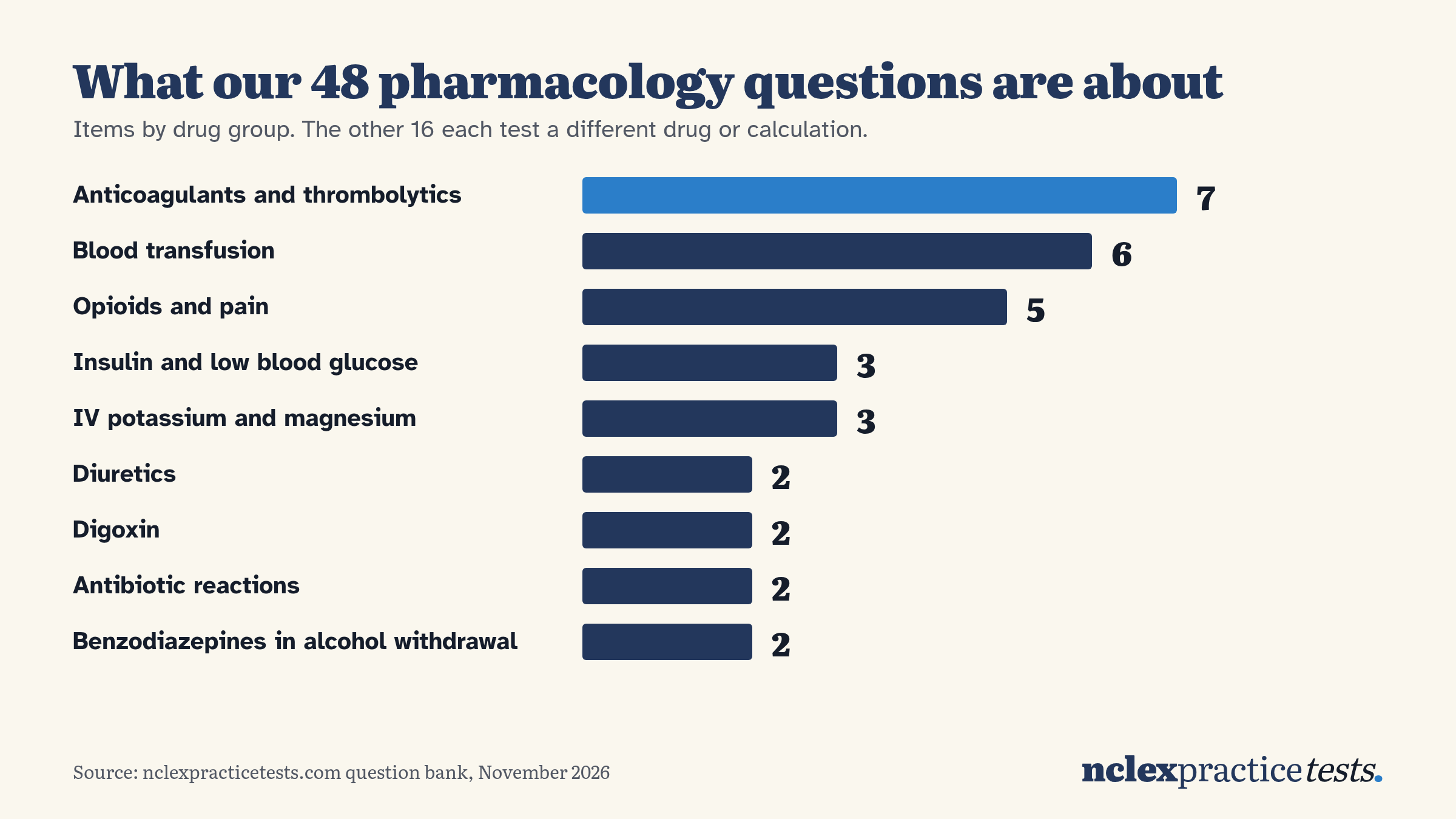
Our bank holds 48 original questions tagged pharmacology. Forty sit in the Pharmacological and Parenteral Therapies category, and 8 more count under other categories, such as a newborn medication question in Health Promotion. Thirty-nine are on the NCLEX pharmacology practice questions page. The other 9 sit inside six-question cases on the case study practice page.
The biggest group is anticoagulants and thrombolytics, with 7 items: warfarin, heparin, enoxaparin and alteplase. Blood products come next with 6, which is why we wrote a separate guide to blood transfusion reactions. Eighteen of the 48 are built on a drug from the ISMP high-alert list.
That pattern follows the 2026 NCSBN test plan, whose Pharmacological and Parenteral Therapies activities include administering blood products, handling high-risk medications safely, and reviewing lab results before a dose. If you have one evening, spend it on the first three rows of the chart.
Three worked questions
The -pril question
This item is on Exam 5.
A client started lisinopril 2 weeks ago for hypertension. The client calls the clinic and reports swelling of the lips and tongue that began an hour ago. What should the nurse tell the client?
- A. Take an over-the-counter antihistamine and skip today’s dose
- B. Keep taking it, since swelling often fades as the body adjusts
- C. Hold the drug for 2 days, then restart it at half the dose
- D. Call emergency services now and take no more doses
Answer: D. The suffix tells you lisinopril is an ACE inhibitor, and the label warns of angioedema of the face, lips and tongue. Swelling of the tongue can close the airway, so this is an emergency. ACE inhibitor angioedema is driven by bradykinin, not histamine, so an antihistamine (A) may not help. The drug is not restarted at any dose (B, C).
The digoxin and furosemide question
This item is on Exam 7.
A client with heart failure takes digoxin and furosemide every morning. Before the morning doses, the client reports nausea and says lights seem to have yellow rings around them. The apical pulse is 64 beats per minute. The potassium level is 3.1 mEq/L. What should the nurse do?
- A. Hold the furosemide and give the digoxin as scheduled
- B. Hold the digoxin and notify the provider
- C. Give the digoxin, since the apical pulse is above 60 beats per minute
- D. Give the digoxin with breakfast to lessen the nausea
Answer: B. Nausea and yellow vision are signs of digoxin toxicity, and the low potassium (likely from the loop diuretic) makes toxicity more likely. The pulse is only one part of the check, which is why C is the trap. Holding only the furosemide (A) still gives a toxic client more digoxin.
The potassium push question
This item is on Exam 2.
An order reads potassium chloride 20 mEq IV push now. The nurse should:
- A. push it slowly over 1 minute
- B. not give it IV push, and clarify the order
- C. push it only if the client’s potassium is low
Answer: B. Concentrated potassium chloride must be diluted before use and is never given as an IV push, which can stop the heart. Speed (A) and a low level (C) do not make a push safe. The nurse clarifies the order before anything is given.
How to use this sheet
Read the suffix table once, then work the pharmacology question set with the action table beside you. When a question names a drug without a suffix, look for it in the “no class suffix” rows. Our 6-week NCLEX study plan puts pharmacology in week 2, and the medical-surgical questions mix drugs into clinical situations, which is how the exam usually asks about them.
The labels, ISMP lists and stem list behind this page are on sources. More guides are on the NCLEX study guide page. This sheet is exam preparation, not clinical guidance: in practice, follow the order, your facility’s protocol and the current drug label.
Frequently asked questions
How much of the NCLEX is pharmacology?
Pharmacological and Parenteral Therapies is 13 to 19% of content items in the 2026 NCSBN test plan, the second largest of the eight categories. Medication questions also show up in safety, risk reduction and management of care, so the real share is higher.
What are the most important drug suffixes for the NCLEX?
Start with the cardiac and clotting stems: -pril, -sartan, -olol, -dipine, -semide, -parin and -xaban. Then the benzodiazepine stem -azepam and the antibiotic stems -cillin, cef-, -mycin, -micin and -oxacin. Each is defined in the official USAN stem list.
Which NCLEX antidotes should I memorize?
Protamine for heparin, vitamin K for warfarin, naloxone for opioids, flumazenil for benzodiazepines, digoxin immune fab for digoxin, acetylcysteine for acetaminophen, idarucizumab for dabigatran, and IV calcium for magnesium toxicity. Each pairing comes from the FDA prescribing information.
Is it enough to memorize drug suffixes?
No. A suffix tells you the class, but insulin, morphine, potassium chloride, magnesium sulfate, digoxin and lithium have no class suffix at all. Those are some of the most dangerous drugs a nurse gives, so learn them by name.
Do I need to know therapeutic drug levels for the NCLEX?
Know which drugs are watched by a level or a lab: digoxin, lithium, heparin (aPTT), warfarin (INR) and vancomycin. The question usually gives the result and the target range, and asks what the nurse does next. Reference ranges vary by lab, so read the one in the question.
Built and maintained by the NCLEX Practice Tests team. Items are original and checked against the published test-plan categories before they go up. Each rationale is reviewed before publish. These are study questions, not official NCSBN items and not medical advice. About this site →