NGN Question Types Explained: Bowtie, Matrix, Cloze, Trend and More
Last updated: October 27, 2026
This guide covers the ten formats you are most likely to meet on the Next Gen NCLEX. When an item has more than one correct answer, NCSBN gives partial credit with three rules: plus/minus, zero/one and rationale scoring. The instruction in the stem tells you which rule applies. “Select all that apply” means wrong picks cost you; “select 2” or a single drop-down means they do not.
This guide shows one original question in each of ten formats, with the answer and the reasoning. All ten are on our free NCLEX Exam 1, so you can read the example here and then answer it in the real layout.
What are NGN questions?
The Next Generation NCLEX (NGN) launched on April 1, 2023, to measure clinical judgment with new item types (NCSBN). Per the 2026 NCLEX-RN Test Plan, clinical judgment is measured by:
- 18 case study items, three cases of six. Each case follows one client through six steps: recognize cues, analyze cues, prioritize hypotheses, generate solutions, take action and evaluate outcomes.
- About 10% stand-alone items, selected depending on exam length.
The exam runs 85 to 150 items in five hours, breaks included, per the same test plan. You cannot skip an item or go back to change an answer (NCLEX FAQ). NCSBN also says there is no set percentage for each item format. You might see three trend items, or none. To fit the case study formats into the weeks before your exam, our NCLEX study plan sets aside week 5 for clinical judgment.
The ten formats at a glance
| Format | What you do | The instruction to look for | Scoring rule |
|---|---|---|---|
| One best answer | Pick one of four | A single question | Right or wrong (one key) |
| Select all that apply | Tick every correct option | Select all that apply | Plus/minus |
| Highlight | Click findings in a note | "Select the findings..." with no number | Plus/minus |
| Highlight in a table | Click rows of a chart | "Select each row that..." | Plus/minus |
| Trend | Read values over time, pick rows | "Select each row whose trend..." | Plus/minus |
| Matrix | One choice per row | "For each..., specify..." | Zero/one per row |
| Drop-down cloze | Fill blanks in a sentence | "Complete the sentence" | Zero/one, or rationale when two blanks are a linked pair |
| Drop-down table | One choice per row from a menu | "For each client, choose..." | Zero/one per row |
| Drag-and-drop ordering | Put steps in sequence | "Put the steps in order" | Not stated in NCSBN's FAQ |
| Bowtie | 2 actions, 1 condition, 2 parameters | A set number in each zone | Zero/one, five points |
The scoring column applies NCSBN’s own definitions, which go by the instruction rather than the layout. Plus/minus is used “when candidates are allowed to select an unspecified number of options.” Zero/one is used “when candidates are instructed to choose a specific number of responses.” Rationale scoring is for a closely linked pair, such as a cause and its effect, where both halves must be right to earn the point (NCLEX FAQ, “How are items scored?”).
NCSBN also uses variants not shown here, such as select N items (zero/one), matrix items that allow more than one choice per row (plus/minus), drag-and-drop versions of cloze and rationale items, and calculation (fill-in-the-blank) items. The same instruction test tells you which rule applies.
Read the instruction before the options. If it says "select all," every pick you are unsure of can cancel one you got right. If it names a number, pick exactly that many and guess freely on the last one.
How plus/minus scoring works on a real item
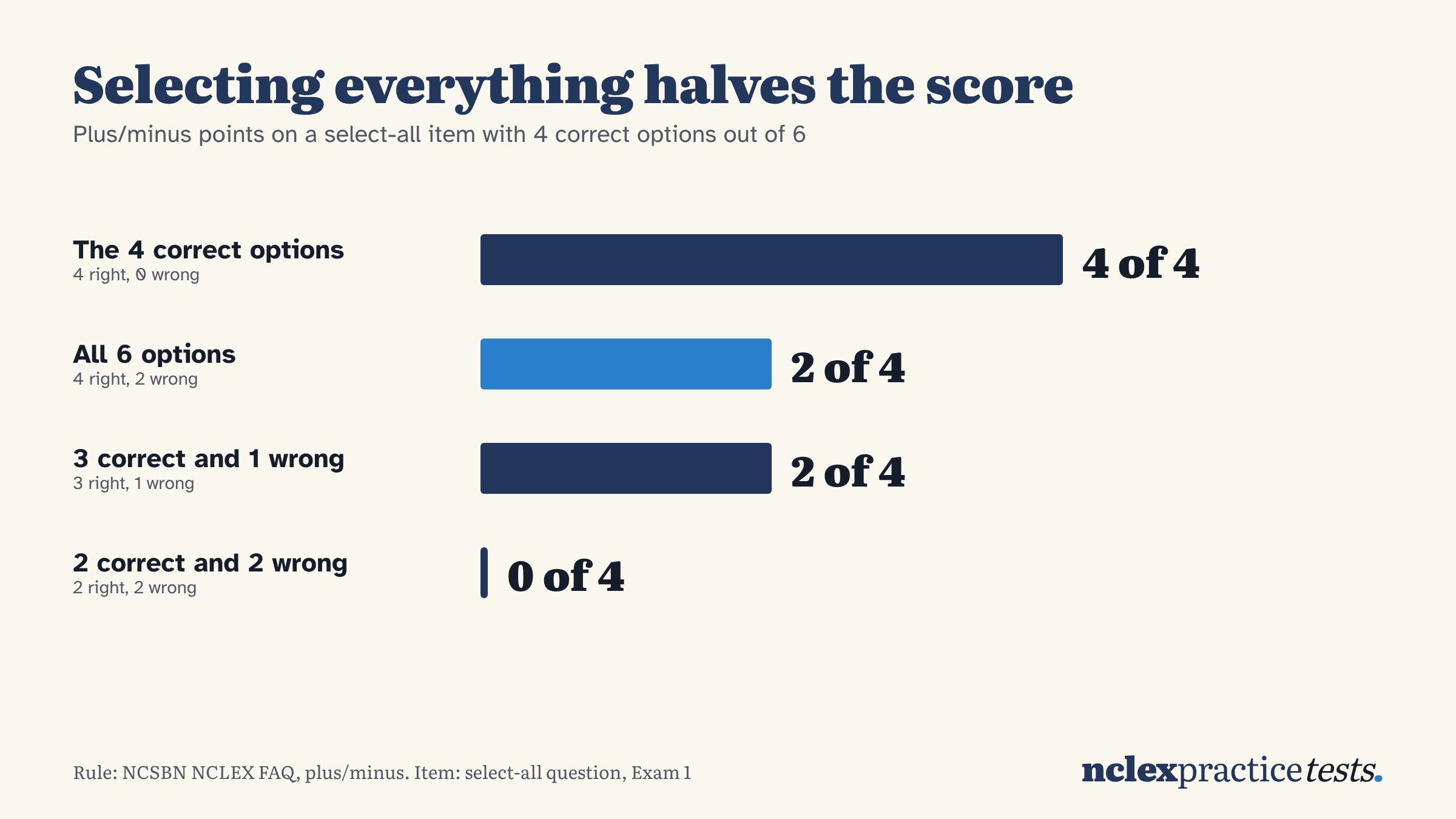
Under plus/minus you earn a point for each correct option and lose one for each incorrect option. In NCSBN’s words, “The maximum score corresponds to the number of correct options, while the minimum score is set at zero” (NCLEX FAQ, “How are items scored?”). Here is the arithmetic on the select-all question from Exam 1 shown in the next section, which has four correct options out of six.
| What you selected | Right | Wrong | Points |
|---|---|---|---|
| The 4 correct options | 4 | 0 | 4 of 4 |
| All 6 options | 4 | 2 | 2 of 4 |
| 3 correct and 1 wrong | 3 | 1 | 2 of 4 |
| 2 correct and 2 wrong | 2 | 2 | 0 of 4 |
Selecting everything is not a safe strategy. It halved the score here. Treat each option as its own true or false question about this client.
Select all that apply
A client is 6 hours after abdominal surgery. The dressing was dry an hour ago. It is now saturated with bright red blood, the heart rate is 122, and the blood pressure is 88/54. Which actions should the nurse take? Select all that apply.
- A. Apply firm pressure over the dressing and reinforce it
- B. Notify the surgeon now
- C. Place the client supine with legs elevated, if not contraindicated
- D. Give the client water so the blood pressure can recover
- E. Start an isotonic IV bolus through a large-bore catheter
- F. Recheck the blood pressure in 2 hours
Answer: A, B, C and E. This is bleeding with early shock. Hold pressure on the bleeding, get the surgeon, support blood pressure with position and isotonic volume. Oral water is too slow and the client may need surgery. A recheck in 2 hours leaves the client hypotensive. This item is on Exam 1 and in our med-surg practice questions.
Highlight
A highlight item shows a note or a chart entry, and you click the parts that matter. Ours on Exam 1 gives five timed notes and asks: Select the findings that require immediate follow-up. Select all that apply.
- 0800: Client is alert and naming the correct month.
- 0810: Client reports a new crushing pressure in the chest that started while resting.
- 0810: Pain does not change with a deep breath or with position.
- 0812: Client asks what time lunch is served.
- 0815: Skin is cool and damp, and the client is nauseated.
Answer: the 0810 pressure, the 0810 pain pattern and the 0815 skin and nausea. Together they fit cardiac ischemia. Pain that does not change with breathing or position points away from a muscle or pleural cause. Being oriented and asking about lunch are not danger signs. The trap is clicking every line that sounds clinical.
Highlight in a table
The same task in rows. Ours lists five safety checks for a client at risk of falls: Select each row that needs follow-up.
- 0800: Bed is in the low position and the call light is in reach
- 0810: A client who is confused is climbing over the side rail
- 0815: The floor beside the bed is dry
- 0820: A wrist restraint is tied to the side rail, and the fingers are pale
- 0830: Non-skid socks are on, and the path to the bathroom is clear
Answer: 0810 and 0820. A confused client climbing the rail is about to fall. A restraint belongs on the bed frame, not the rail, and pale fingers mean it is too tight. The other three rows are precautions working as they should. Our prioritization questions include this item too.
Trend
A trend item gives the same measures on several days. You judge the direction, not one number. A client takes spironolactone. Select each row whose trend means the nurse should hold the drug and call the provider.
| Row | Monday | Wednesday | Friday |
|---|---|---|---|
| Potassium | 4.4 mEq/L | 5.1 mEq/L | 5.9 mEq/L |
| Blood pressure | 148/86 | 136/80 | 128/76 |
| Weakness | None | Mild | New, and the client cannot make a fist |
| Weight | 82 kg | 81 kg | 80.5 kg |
Answer: potassium and weakness. Spironolactone is potassium-sparing, so a climb to 5.9 mEq/L is a reason to hold it. New weakness with that rise suggests the potassium is affecting muscle. The falling blood pressure and slow weight loss are the effects the drug was ordered for. More drug items like this are in our pharmacology questions.
Matrix
A matrix gives several rows and the same columns for each. You make one choice per row, and each row is its own point. For each teaching point, specify if it is indicated.
| Teaching point | Answer |
|---|---|
| A 10-month-old may have soft finger foods, and not whole grapes | Indicated |
| A pregnant client at 10 weeks should stop the prenatal vitamin | Not indicated |
| Ask an older adult whether influenza and pneumococcal vaccines are due | Indicated |
| Honey is safe in a bottle for a 2-month-old | Not indicated |
Whole grapes are a choking hazard. The prenatal vitamin continues unless the provider stops it. Honey is not given in the first year because of the risk of infant botulism. Since each row scores on its own, one weak row does not cost the others.
Drop-down cloze
A sentence with one or more menus. A client with type 1 diabetes is sweaty, shaky, and has a fingerstick glucose of 52 mg/dL. The client is awake and can swallow. The nurse should first [give the full dose of scheduled insulin / start the client on a regular diet tray in an hour / give 15 g of a fast carbohydrate], then recheck the glucose in 15 minutes.
Answer: give 15 g of a fast carbohydrate. That is the 15-15 approach for an awake client who can swallow. Insulin would push the glucose lower, and an hour is too long to wait. When a cloze has two blanks that form a linked pair, such as a condition and the finding that shows it, that pair may be scored under the rationale rule: both blanks right, or no point for the pair.
Drop-down table
A table where each row has its own menu. For each client, choose the teaching that fits.
| Client | Options | Answer |
|---|---|---|
| A 10-month-old | Whole grapes as a snack; soft finger foods, cut up; honey in the bottle | Soft finger foods, cut up |
| A pregnant client at 12 weeks | Take the prescribed prenatal vitamin; start a weight-loss diet; stop the prenatal vitamin | Take the prescribed prenatal vitamin |
| An adult turning 50 | Ask about the screening that is due at this age; skip screening until symptoms start; colon and breast screening are only for people who feel ill | Ask about the screening that is due at this age |
The skill is the same as a matrix, with different options in each row. Read each row as a separate one best answer question.
Drag-and-drop ordering
Put the steps in order for mixing regular insulin and NPH in one syringe. The options include two that do not belong: drawing glargine into the same syringe, and shaking the NPH vial until it froths.
Answer: inject air into the NPH vial, inject air into the regular vial, draw up the regular insulin, then draw up the NPH. Clear before cloudy keeps NPH out of the regular vial. Glargine is not mixed with other insulins, and NPH is rolled, not shaken. Our ordering items include extra options that do not belong, so check each card before you place it.
Bowtie
A client with a bleeding gastric ulcer is pale, thirsty, and dizzy. Heart rate 128. Blood pressure 86/50. Urine output 15 mL for the past hour. Choose two actions, one condition and two parameters to monitor.
| Actions to take (pick 2) | Condition (pick 1) | Parameters to monitor (pick 2) |
|---|---|---|
| Apply oxygen and stay with the client | Hypovolemic shock | Blood pressure and heart rate |
| Place the client in Trendelenburg and leave the room to find a blanket | Anaphylaxis | Fasting lipid panel |
| Insert a large-bore IV and infuse an isotonic bolus | Cardiogenic shock from an acute infarction | Urine output |
| Encourage the client to drink a liter of water | SIADH | Pupil size every 15 minutes |
Answer in bold. Start in the middle: bleeding, a fast heart rate, low blood pressure and low urine output are hypovolemic shock. Then each side follows from the condition. Volume and oxygen treat it, and blood pressure, heart rate and urine output show whether it is improving. Anaphylaxis has no allergen or wheeze here, and SIADH is a water problem, not blood loss.
Solve the bowtie from the middle out. Name the condition first. The right actions and parameters are the ones that treat and track that condition, and the distractors usually fit one of the wrong conditions.
One best answer
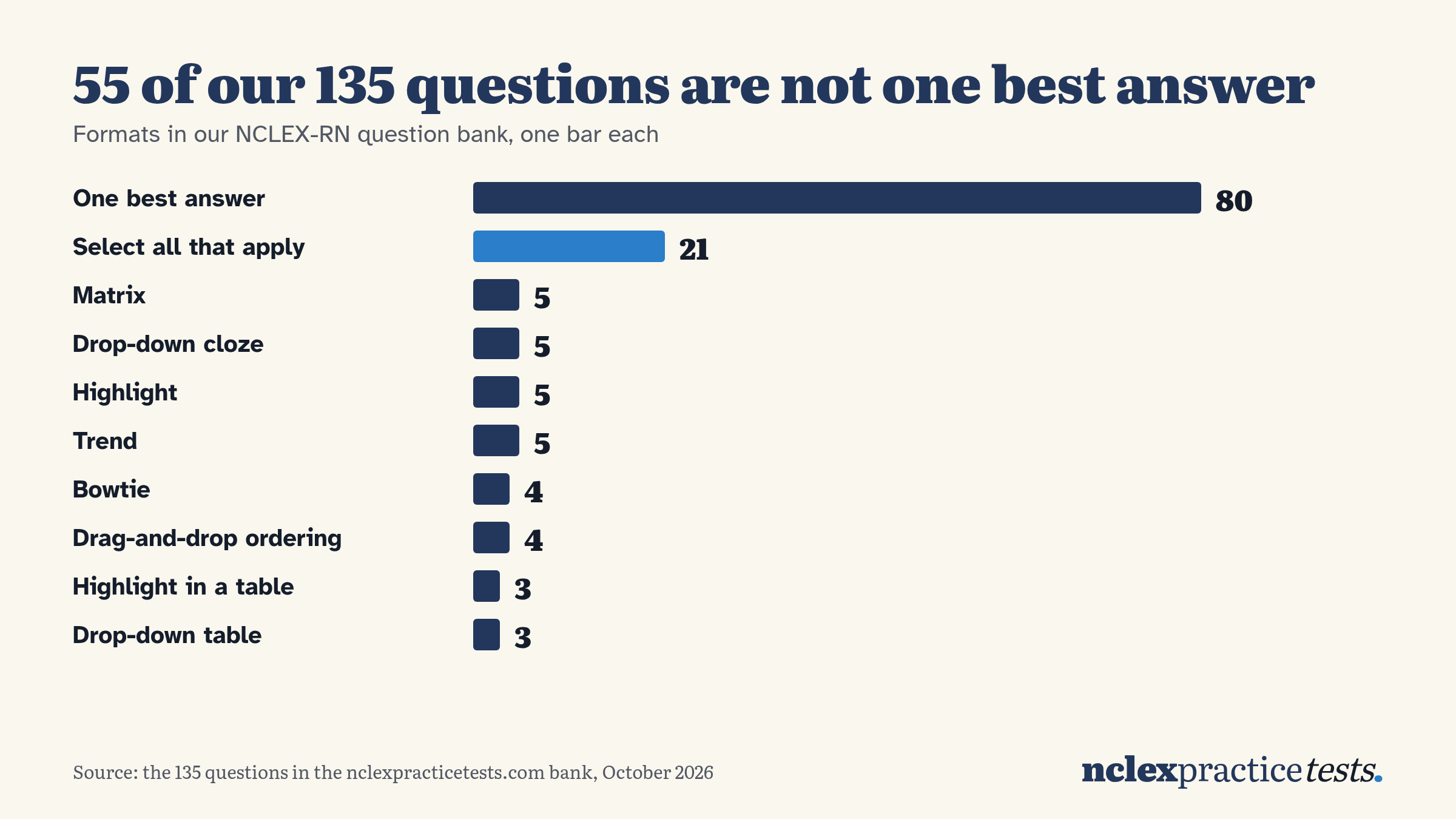
Single-answer items are still the most common format in our bank: 80 of our 135 items. They are scored right or wrong. This one is on Exam 1.
Which client should the nurse assess first?
- A. A client who is two days after a knee replacement and rates incisional pain at 6 out of 10
- B. A client whose scheduled oral antibiotic is due in 45 minutes
- C. A client who asks to walk to the bathroom and has been steady with a walker
- D. A client with heart failure who is short of breath while resting in bed and has new crackles at both lung bases
Answer: D. New shortness of breath at rest with new crackles is a breathing problem, so this client comes first. Pain of 6 out of 10 needs treatment but is not immediately life-threatening. A medication not yet due can wait, and so can a steady client who wants to walk.
Our prioritization guide works through several and shows the order of rules that answers most of them.
Which formats show up in case studies?
A case study is defined by its six steps, not by a format, and the test plan does not list which formats each step uses. Bowtie and trend items were introduced as stand-alone types, outside the six-item cases (Simpson, Boev and Dambaugh, 2023). In our eight case study sets, three cases use one best answer for five steps and select all that apply for generate solutions. The other five, starting with the stroke case on Exam 4, use a highlight to recognize cues, a drop-down cloze to analyze them, a matrix to generate solutions and a trend layout to evaluate outcomes. That last item is practice in reading values over time inside a case, not a claim that the NCLEX places stand-alone trend items in cases. Our guide to NCLEX case study questions works one of those cases item by item.
The step tells you the task more than the layout does. Recognize cues asks what matters in the chart. Evaluate outcomes asks whether the client got better, so it often shows values over time.
How to practice the formats
In our 135-item bank, 55 items (41%) use a format other than one best answer. Exam 1, Exam 2 and Exam 3 each include all ten formats and one six-question case.
- Take Exam 1 in Study mode and check each answer as you go. Every example above is in it.
- Before you answer, say which scoring rule applies. It changes how much you should guess.
- Then sit Exam 2 with the 60-minute timer on, so the layouts stop costing you time.
Every item here is original and written to the NCSBN test plan categories, as described on how questions are written. This is study material, not clinical guidance, and a practice score does not predict an NCLEX result. The NCSBN documents behind this guide are listed on sources, and more guides are on the study guide page.
Frequently asked questions
How many NGN questions are on the NCLEX?
Per the 2026 NCLEX-RN test plan, clinical judgment is measured by 18 case study items (three cases of six) plus about 10% stand-alone items, chosen depending on exam length. NCSBN does not set a percentage for each format, so the number of bowtie, matrix or trend items varies from one candidate to the next.
Is there partial credit on the NCLEX?
Yes, for items with more than one correct answer. NCSBN uses three rules: plus/minus, zero/one and rationale scoring. A one best answer item has a single key, so it is right or wrong.
Do wrong answers take away points on the NCLEX?
Only under the plus/minus rule, which applies when you choose how many options to select, as in select all that apply. Each wrong pick cancels a right one, but NCSBN sets the minimum score for the item at zero. Under zero/one, a wrong choice simply earns nothing.
What is a bowtie question on the NCLEX?
A bowtie asks for five answers in one item: the client's most likely condition in the middle, two actions to take on one side and two parameters to monitor on the other. Because it tells you exactly how many to pick in each part, each correct pick earns a point and a wrong pick earns nothing.
What is the hardest NGN question type?
There is no official answer, and difficulty depends on the content more than the layout. Select all that apply and other unlimited-selection formats punish guessing the most, because each wrong pick cancels a right one.
Built and maintained by the NCLEX Practice Tests team. Items are original and checked against the published test-plan categories before they go up. Each rationale is reviewed before publish. These are study questions, not official NCSBN items and not medical advice. About this site →