How to Answer NCLEX Prioritization Questions
Last updated: October 20, 2026
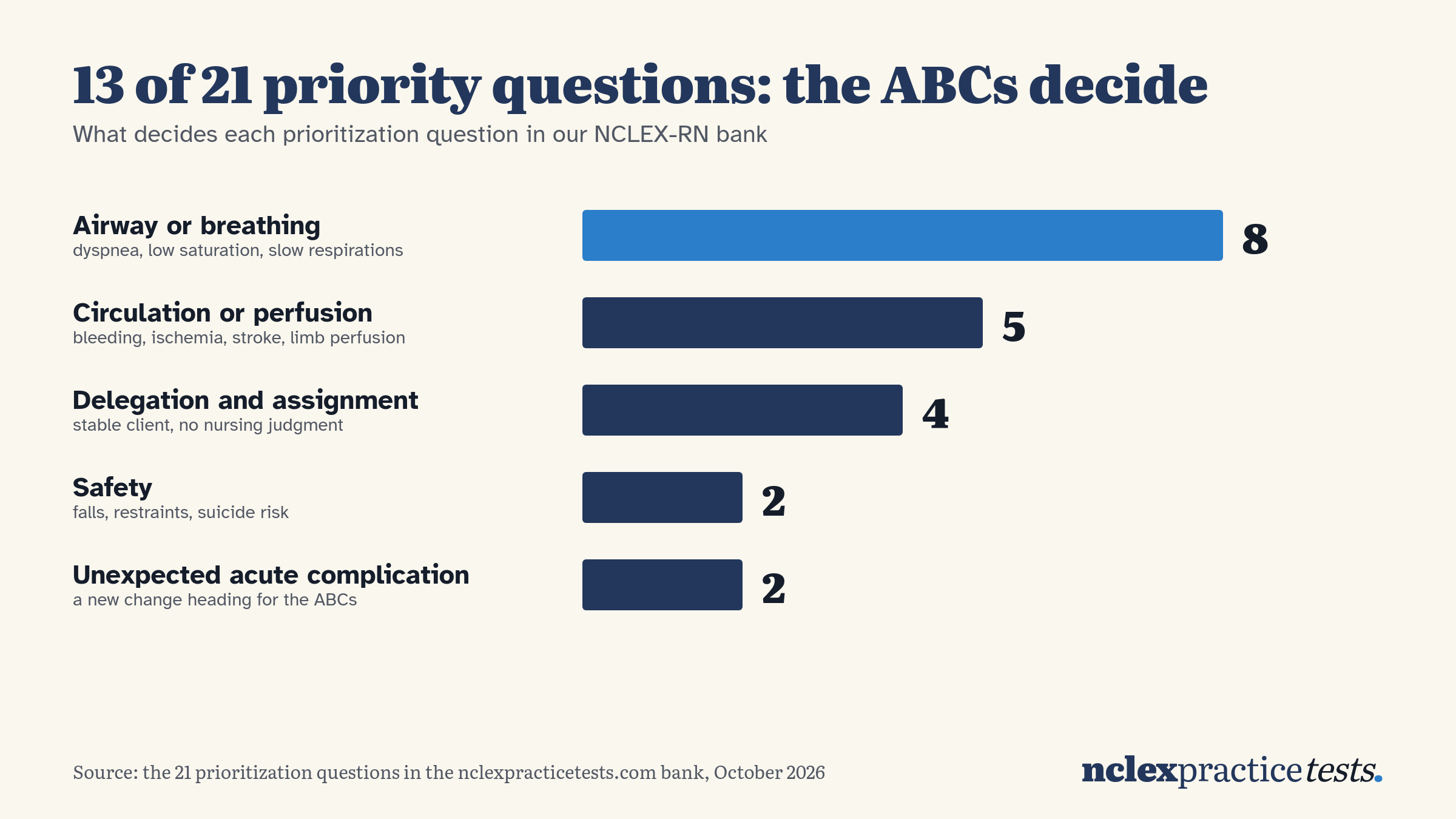
To answer an NCLEX prioritization question, test the options in a fixed order: airway, breathing, circulation, then immediate safety, then the new or unexpected change. In the 21 prioritization questions in our bank, the ABCs alone decide 13. Delegation questions use one more test: is the client stable and the task free of nursing judgment?
Most students know the frameworks. The trouble is applying them under time pressure when every option sounds reasonable. This guide gives the order, shows it working on three of our practice questions, and lists the traps that cost points.
How much of the NCLEX is prioritization?
Prioritization and delegation sit in Management of Care, which is 15 to 21% of the exam in the 2026 NCLEX-RN Test Plan. It is the largest of the test plan’s eight content areas. The tested activities named under it include “Prioritize the delivery of client care based on acuity” and using the rights of delegation.
A minimum-length exam is 85 items. Per the same test plan, 52 come from the eight content categories, so Management of Care accounts for roughly 8 to 11 of them. That weight is why our 6-week NCLEX study plan gives it the first week. Another 18 items are three case studies, and each case has a prioritize hypotheses step that asks which problem matters most.
Not every Management of Care item is about prioritization, since the category also covers consent, advocacy and confidentiality. But priority thinking also decides “what first” questions in other categories, such as treating a low blood pressure after surgery or reversing an opioid.
What decides a prioritization question?
We sorted the 21 prioritization questions in our bank by the one rule that picks the right answer:
| Deciding rule | Items | Example finding that wins |
|---|---|---|
| Airway or breathing | 8 | New crackles and shortness of breath at rest; respiratory rate of 8 after morphine |
| Circulation or perfusion | 5 | Bright red bleeding with a blood pressure of 88/54; new one-sided weakness; cast pain on passive stretch |
| Delegation and assignment | 4 | A stable client with a routine task; a glucose of 42 stays with the nurse |
| Safety | 2 | A confused client climbing the side rail; a client saving sleeping pills |
| Unexpected acute complication | 2 | Bowel visible through the incision; tingling around the mouth after thyroidectomy |
| Total | 21 |
Thirteen of 21 come down to the ABCs. That is the pattern to train first: when one option describes a real airway, breathing or circulation problem, it is almost always the answer.
Actual beats potential. The ABC rule applies to a problem the client has now. "Risk for" anything, a medication due in 45 minutes, or teaching planned for tomorrow can wait for the client whose breathing has changed.
The order to apply the rules
Run each option through these questions in order. Stop at the first one that separates them.
- Is there an actual airway or breathing problem? New dyspnea, a falling saturation, stridor, a respiratory rate that is too slow or too fast.
- Is circulation or perfusion failing? Bleeding with low blood pressure, chest pain at rest, new stroke signs, a limb losing perfusion.
- Is there an immediate safety risk? A fall about to happen, a restraint cutting off circulation, a suicide plan with access to the means.
- Is it new, unexpected or getting worse? A change from baseline beats a finding that is abnormal but expected for the condition.
- Physical need or something else? Basic physiological needs come before teaching, discharge planning and emotional needs (Maslow).
For delegation, ask two more questions: is the client stable, and does the task need assessment, teaching, evaluation or judgment? Both answers have to be right.
NCSBN describes the prioritize hypotheses step as weighing urgency, likelihood, risk, difficulty and time constraints (test plan, Clinical Judgment). The list above is that weighing done in a set order, so you are not starting from scratch on every item.
Five ways the question is asked
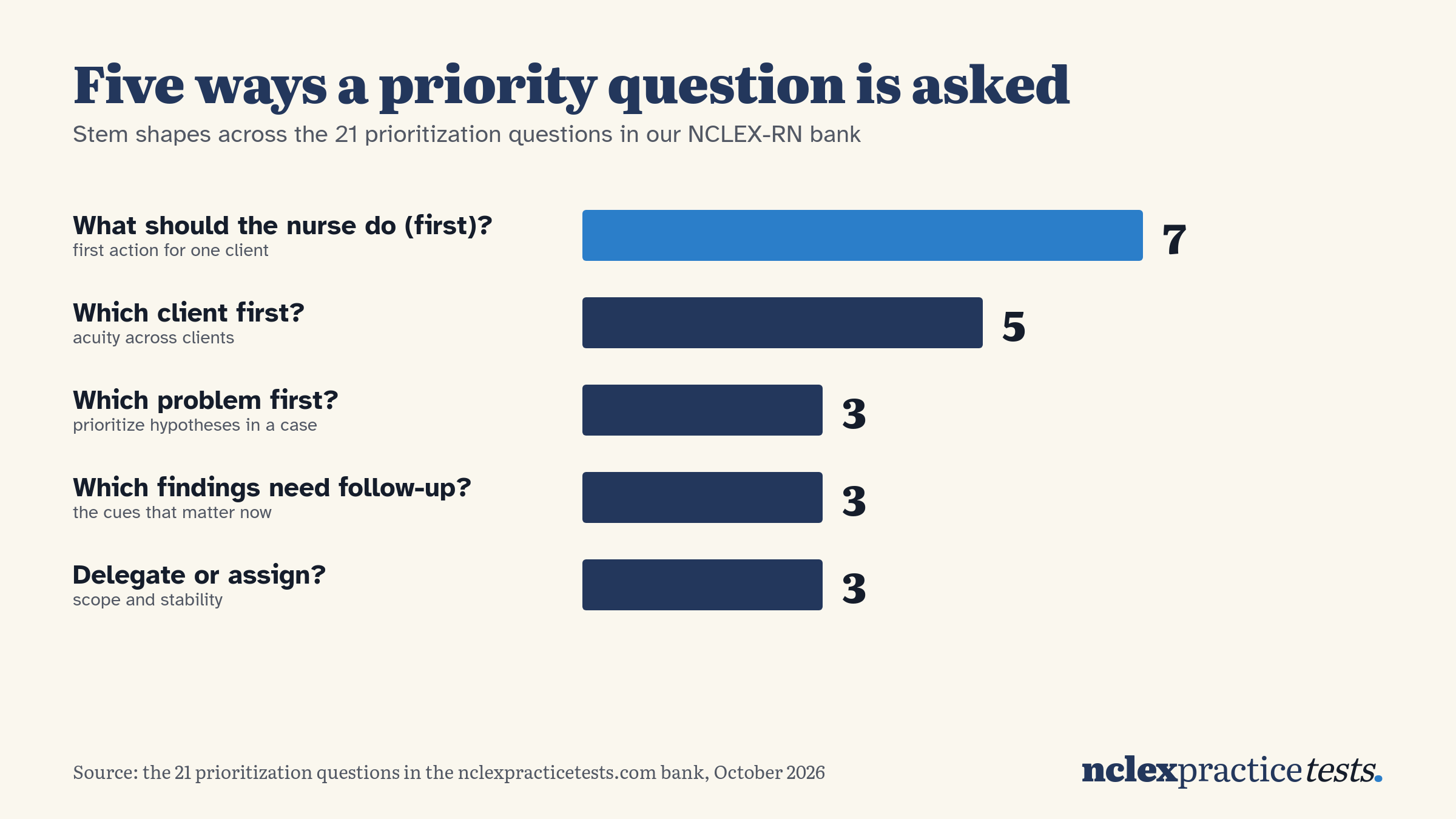
The same 21 items use five stem shapes. Each shape has a typical trap:
| Stem | Items | What it tests | The trap |
|---|---|---|---|
| What should the nurse do (first)? | 7 | The first action for one client | Calling the provider or charting before the action that keeps the client alive |
| Which client should the nurse see first? | 5 | Acuity across several clients | Picking the abnormal lab that is stable for the condition |
| Which problem should the nurse treat first? | 3 | Prioritize hypotheses in a case | Picking the problem you can teach about |
| Which findings need follow-up? | 3 | Recognizing the cues that matter | Selecting every abnormal finding, not only the urgent ones |
| Which task can be delegated or assigned? | 3 | Scope and stability | Delegating a "simple" task for a client who is not stable |
Four of the five shapes are on our prioritization and delegation questions, which hold 15 of these items with a reason on every choice. The “which problem first” items are part of the case studies.
Worked example 1: which client first?
This item is on Exam 1 and the prioritization set.
Which client should the nurse assess first?
- A. A client who is two days after a knee replacement and rates incisional pain at 6 out of 10
- B. A client whose scheduled oral antibiotic is due in 45 minutes
- C. A client who asks to walk to the bathroom and has been steady with a walker
- D. A client with heart failure who is short of breath while resting in bed and has new crackles at both lung bases
Answer: D. Run the order. Step 1, breathing: only D has a breathing problem, and it is new. Stop there. Pain of 6 out of 10 needs treatment but is not immediately life-threatening. A medication that is not due yet is not the priority. A steady client who wants to walk can wait.
Notice that A is a real need, which is what makes it tempting. The question is not whether pain matters. It is whose condition gets worse fastest if you go somewhere else first.
Worked example 2: when everything looks abnormal
Harder items take away the easy distractors. Every option below is a real finding. This one is on the prioritization set.
The nurse has received report on four clients. Which client should the nurse assess first?
- A. A client with chronic kidney disease whose potassium this morning is 5.1 mEq/L, the same as yesterday
- B. A client 1 day after a total thyroidectomy who reports numbness and tingling around the mouth
- C. A client 2 days after an appendectomy who rates incisional pain at 4 out of 10 and asks for the ordered analgesic
- D. A client with a new colostomy whose stoma is pink and moist with a small amount of brown stool
Answer: B. Steps 1 to 3 do not separate the options on the surface, so step 4 does: what is new and unexpected? Numbness and tingling around the mouth after a total thyroidectomy suggest low calcium from injury to the parathyroid glands. It can progress to tetany and laryngeal spasm, which brings it back to the airway.
A potassium of 5.1 mEq/L is mildly high but unchanged in a client with kidney disease. It needs monitoring, not the first visit. Moderate pain on day 2 is expected. A pink, moist stoma passing stool is a healthy finding.
Abnormal is not the same as urgent. A number outside the normal range that matches the client's baseline usually loses to a new symptom that is heading toward the airway or circulation.
Prioritize hypotheses in a case study
In a Next Generation case study, the prioritize hypotheses item lists nursing problems, not clients. We checked the three such items in our older cases (one on each of Exam 1, Exam 2 and Exam 3). In all three, the answer was impaired gas exchange or airway clearance, and every wrong option was teaching, discharge readiness, nutrition or a psychosocial need.
That is Maslow and actual versus potential working together. “Risk for imbalanced nutrition next week” is potential and far away. “Deficient knowledge about inhalers” is real, but teaching waits until the client can breathe. “Risk for loneliness” matters and is not the first problem while the saturation is 86%.
Our newer infant dehydration case breaks that pattern: the priority is hypovolemia, and the distractors are real but slower problems such as a mild acidosis and a low potassium. Our guide to NCLEX case study questions works that case from the first cue to the last outcome.
Delegation: stable client, predictable task
The NCSBN and ANA National Guidelines for Nursing Delegation (2019) set out the five rights of delegation: right task, right circumstance, right person, right directions and communication, and right supervision and evaluation. Two lines from that document decide most exam items:
- Right circumstance: the client’s condition must be stable.
- What stays with the nurse: the licensed nurse cannot delegate clinical reasoning, nursing judgment or critical decision making.
In practice that means assessment, evaluation, teaching and care of an unstable client stay with the RN. This select-all item is on the prioritization set.
The nurse is working with assistive personnel (AP) on a medical unit. Which tasks can the nurse delegate to the AP? Select all that apply.
- A. Take vital signs for a client admitted 2 days ago whose readings have been stable
- B. Walk a client for the first time after a hip replacement whose blood pressure dropped on standing this morning
- C. Give oral care to a stable client who is on bed rest
- D. Complete the admission assessment for a client who just arrived from the emergency department
- E. Explain the discharge instructions to a client going home with a new PICC line
- F. Measure and record intake and output for a client on a fluid restriction
Answer: A, C and F. Each is routine, has a predictable outcome, and is for a stable client. The AP reports the numbers and the nurse interprets them.
B fails right circumstance: a first walk after surgery with a drop in blood pressure is not predictable, so the nurse assesses the client and walks with them first. D is assessment. E is teaching, which includes checking what the client understood. Walking a client is not off limits in general. It depends on the client.
Traps that cost points
- “Call the provider” as the first action. Notifying is often correct and often second. When the stem gives you something you can do at the bedside to support breathing or circulation, do that first. In our morphine item on Exam 2, the first steps for a client with a respiratory rate of 8 are to try to arouse them, call for help, and support breathing if needed. Naloxone and a recheck follow. The same rule decides blood transfusion reaction items: stop the blood at the bedside first, then notify.
- Assess or act? Assess first when you do not yet know what is wrong. When the stem already gives a clear emergency, such as a saturation of 86% or visible bowel, the answer is the action.
- Leaving the bedside. An option that sends the client away for imaging, or sends the nurse away to finish a medication round, is rarely right for an unstable client.
- Medication timing. A scheduled medication that is not yet due is almost never first. A medication question that involves a dangerous effect, such as opioid sedation, is a breathing question. The morphine item above is also in our pharmacology questions.
How to practice
Take the prioritization and delegation set in Study mode and, before you check each answer, say out loud which step of the order decided it. If you cannot name the step, read the rationale on every option. To practice the same order on adult medical and surgical clients, mixed in with other med-surg findings, work through the med-surg practice questions. Then sit a full practice exam timed to see how priority items feel mixed with everything else.
Our questions are original and written to the client-needs categories in the NCSBN test plan, as explained on how questions are written. They are study material, not clinical guidance, and a score here does not predict an NCLEX result. The documents behind this guide are listed on sources.
Frequently asked questions
What is the order of priority on the NCLEX?
Start with an actual threat to the airway, breathing or circulation. Then look for an immediate safety risk, then a new or unexpected change over a stable or expected finding. Basic physiological needs come before teaching, discharge planning and psychosocial needs.
Do the ABCs or Maslow's hierarchy come first?
They do not compete. The ABCs are the top of Maslow's physiological level, so a real airway, breathing or circulation problem wins either way. Maslow is most useful when no option threatens the ABCs, for example when you have to choose between a physical need and teaching or emotional support.
How many prioritization questions are on the NCLEX?
NCSBN does not publish a count for prioritization alone. Management of Care, the category that holds prioritization and delegation, is 15 to 21% of the exam in the 2026 NCLEX-RN test plan. Every case study also has a prioritize hypotheses item, and priority thinking shows up in other categories too.
What can an RN not delegate to assistive personnel?
Anything that needs clinical reasoning, nursing judgment or critical decision making. That covers assessment, evaluation, teaching and care of an unstable client. Routine tasks with a predictable outcome for a stable client, such as vital signs, hygiene and intake and output, can be delegated.
What if every option on a priority question is correct?
They often are. The question asks which one comes first, so ask which client or finding causes harm soonest if you wait. A correct action that can safely wait ten minutes loses to one that cannot.
Built and maintained by the NCLEX Practice Tests team. Items are original and checked against the published test-plan categories before they go up. Each rationale is reviewed before publish. These are study questions, not official NCSBN items and not medical advice. About this site →