NCLEX Case Study Questions: How the Six-Item Case Works and How to Work It
Last updated: November 17, 2026
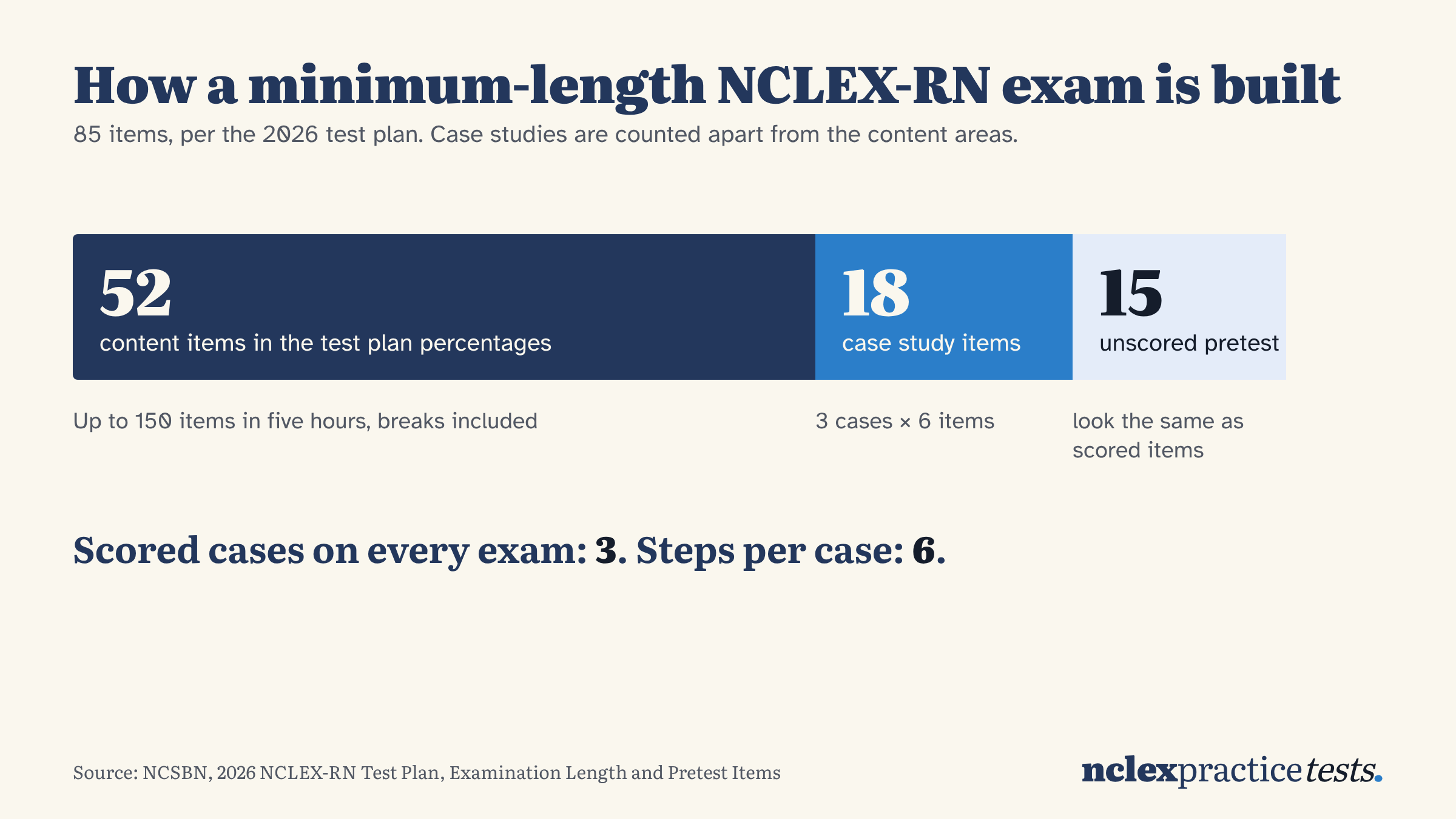
The NCLEX-RN scores three case studies, each a set of six items about one client, for 18 case items on every exam. Each of the six items tests one step of clinical judgment: recognize cues, analyze cues, prioritize hypotheses, generate solutions, take action and evaluate outcomes. Both numbers come from the 2026 NCLEX-RN Test Plan.
This guide explains how a case is built, why some students count more than three, and what each step asks. Then it works one of our original cases item by item. You can sit the same case on our free NCLEX Exam 5.
What is an NCLEX case study?
Per the test plan, a case study “contains six items that are associated with the same client presentation, share unfolding client information and address the following steps in clinical judgment.” In practice, that means three things.
- One client. A chart opens with tabs such as history, nurses’ notes, vital signs and labs.
- Unfolding. New notes, orders or results appear as the case moves on. Item 5 may show a change that did not exist at item 1.
- Six steps. Each item lines up with one step of the NCSBN Clinical Judgment Measurement Model (NCJMM).
The test plan also says you cannot return to an item once you confirm it and press Next. Inside a case, that matters more than anywhere else. You cannot fix item 2 after item 4 shows you what was really going on.
How many case studies are on the NCLEX?
Three scored ones. The test plan spells out a minimum-length exam of 85 items: 52 content items in the test plan percentages, 18 items that “comprise three clinical judgment case studies,” and 15 unscored pretest items. The exam can run to 150 items in five hours, breaks included. Clinical judgment is also measured by about 10% stand-alone items, chosen by exam length.
If you count more than three cases on test day, the test plan offers one explanation. There are 15 pretest items on every exam, and they “have similar style and format as operational items,” so you cannot tell them apart. NCSBN does not say how many pretest items, if any, come as case studies. But 15 items hold at most two more six-item sets.
Treat every case as scored. You cannot tell a pretest case from a real one, and a count of cases tells you nothing about how you are doing.
How are case study items scored?
There is no separate case rule. Each item is scored by its format, and the test plan says partial credit applies to items with more than one key, under three methods: plus/minus, zero/one and rationale scoring. A one best answer item inside a case is simply right or wrong.
Because each item stands alone for scoring, a miss on item 2 does not cost you item 3. Our guide to NGN question types shows how each rule works, with the arithmetic on a select-all item.
What each of the six steps asks
The left two columns follow NCSBN’s definitions. The right two come from the 48 case items in our bank: eight cases of six. The stem wording is ours, but it is the kind of wording to look for.
| Step | NCSBN: what the nurse does | What the stem asks | Formats in our 48 items | The trap |
|---|---|---|---|---|
| 1. Recognize cues | Identify relevant and important information | "Select the findings that require immediate follow-up" | 5 highlight, 3 one best answer | Clicking every abnormal-sounding line, including normal or expected ones |
| 2. Analyze cues | Connect the cues to the client's presentation | "Which condition best explains..." or a sentence to complete | 5 drop-down cloze, 3 one best answer | Naming a condition that fits one cue but not the cluster |
| 3. Prioritize hypotheses | Rank the possible problems by urgency, likelihood and risk | "Which problem is the priority?" | 6 one best answer | Picking a real but slower problem over the one that threatens perfusion or breathing now |
| 4. Generate solutions | Set expected outcomes and the interventions that reach them | "For each action, specify indicated or not indicated" | 5 matrix, 3 select all | Letting one wrong row drag the others; each row is its own decision |
| 5. Take action | Carry out the solution for the highest priority | "What should the nurse do first?" or a calculation | 10 one best answer | A correct action in the wrong order, or a dose worked from the wrong weight |
| 6. Evaluate outcomes | Compare what happened with what was expected | "Select each row whose trend needs follow-up" | 5 values over time, 3 one best answer | Calling the case improved because most rows improved |
Two things stand out in the counts. First, the action steps lean on one best answer: all 10 take action items use it. Second, the steps where more than one answer can be right (recognize cues, generate solutions, evaluate outcomes) are where our cases use highlight, matrix, select all and trend formats. In six of our eight cases, item 3 asks for the priority problem. In the stroke case on Exam 4 and the postpartum case on Exam 6, item 3 is a time-critical first action, so those two cases carry two take action items and no prioritize item. That departs from the NCLEX pattern, where each case measures all six steps, so use the other six cases to practice the prioritize step.
One case worked through: an infant with dehydration
This case is on Exam 5 and in our case study practice set. Read it here, then sit it with the chart tabs.
The chart at the start. Leo Tran is 10 months old, with 2 days of vomiting and watery diarrhea and only small sips of formula since yesterday. He weighed 9.0 kg at a well-child visit 2 weeks ago and weighs 8.3 kg today. At 1100 the heart rate is 164, the blood pressure 86/52, and the oxygen saturation 99% on room air. Labs at 1115 show a bicarbonate of 17 mEq/L and a potassium of 3.4 mEq/L.
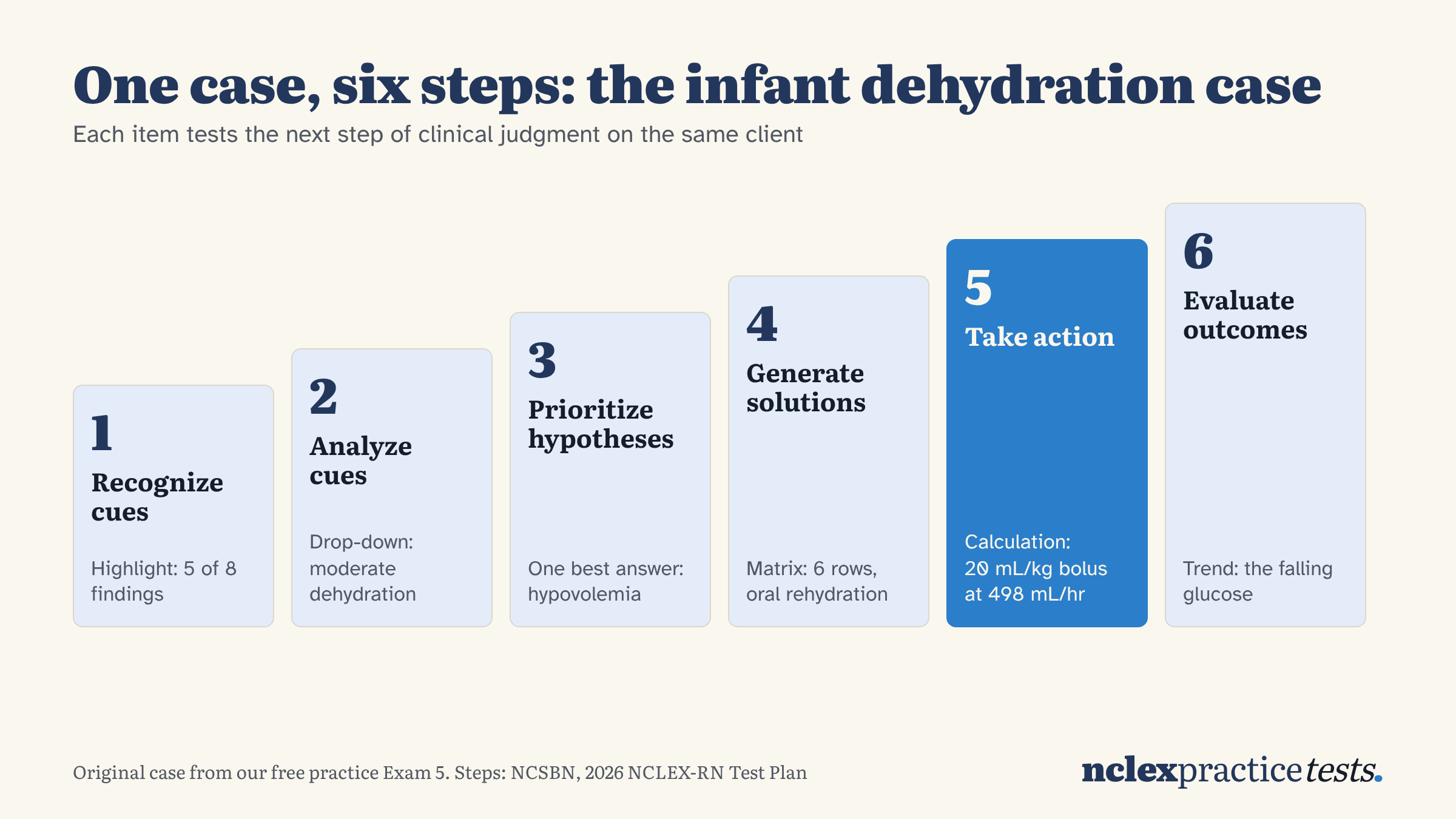
Item 1: recognize cues (highlight)
The nurse reviews the 1100 note. Select the findings that require immediate follow-up. Select all that apply.
- A. Reaches for and tracks the parent across the room.
- B. Cries without tears.
- C. Mucous membranes are dry and sticky.
- D. Anterior fontanel is sunken.
- E. Posterior fontanel is closed.
- F. Capillary refill is 3 seconds.
- G. Breath sounds clear in all fields.
- H. Parent reports the last wet diaper was 10 hours ago.
Answer: B, C, D, F and H. Each is a sign of fluid loss: no tears, dry membranes, a sunken anterior fontanel, refill longer than 2 seconds and very low urine output. The trap is E. The posterior fontanel normally closes by about 2 months, so a closed one at 10 months is expected. A and G are normal, and they become baselines to watch.
Item 2: analyze cues (drop-down cloze)
The item asks you to complete one sentence: the infant’s condition is best described as severe dehydration with shock, moderate dehydration, mild dehydration or fluid volume excess. Answer: moderate dehydration. The infant lost 0.7 kg of 9.0 kg, about 8% of body weight, and the signs from item 1 fit. He is still alert with a normal blood pressure for age, so this is not shock. Earlier CDC and AAP guidance, summarized in a 2003 CDC report, graded dehydration as mild at 3% to 5% loss, moderate at 6% to 9%, and severe at more than 10%. The 2003 report itself groups mild and moderate together as 3% to 9% (CDC, 2003).
Item 3: prioritize hypotheses (one best answer)
The nurse reviews the 1100 assessment and the 1115 laboratory results. Which problem is the priority?
- A. Hypovolemia from vomiting and diarrhea
- B. Metabolic acidosis from lost bicarbonate
- C. Hypokalemia from potassium lost in stool
- D. Fever from the gastrointestinal infection
Answer: A. Slow refill, no wet diaper for 10 hours and an 8% weight loss, together with a fast heart rate, all say circulating volume is low. Restoring volume protects the brain and kidneys, and it corrects much of the acid-base change too. B and C are real findings, which is what makes them good distractors. A bicarbonate of 17 is mild, and a potassium of 3.4 is watched and rechecked. Potassium is not added to IV fluid until the infant is passing urine. Our prioritization guide lays out the order of rules behind choices like this one.
Item 4: generate solutions (matrix)
New orders appear: a trial of oral rehydration, strict intake and output, and a weight recheck in 4 hours. For six actions you mark indicated or not indicated. Indicated: small amounts of oral rehydration solution by syringe or spoon every few minutes, weighing each diaper, and restarting the usual full-strength formula once rehydrated. Not indicated: switching to a sports drink, withholding all fluids for 4 hours after each vomit, and giving loperamide. CDC guidance says antidiarrheal medications are not recommended for infants and children, and that full-strength formula is usually tolerated. Each row scores on its own, so judge it alone.
Item 5: take action (calculation)
The case unfolds. At 1330 the infant has vomited most of the solution and is now sleepy, with a refill of 4 seconds. The order reads: 0.9% sodium chloride 20 mL/kg IV over 20 minutes, using today’s weight.
At what rate should the nurse set the infusion pump?
- A. 166 mL/hr
- B. 249 mL/hr
- C. 498 mL/hr
- D. 540 mL/hr
Answer: C. The volume is 20 mL/kg × 8.3 kg = 166 mL. Giving 166 mL in 20 minutes means 166 ÷ 20 × 60 = 498 mL/hr. A is the volume, not the rate, and would take an hour. D uses the 9.0 kg weight from before the illness, which the order rules out. This is the trap the unfolding chart sets: two weights are on file, and the item tells you which one counts.
Item 6: evaluate outcomes (trend)
A table shows five rows at 1330, 1400 and 1600. Heart rate falls from 172 to 136. Refill goes from 4 seconds to 2. The infant goes from sleepy to alert. The first wet diaper appears. But the point-of-care glucose drops from 68 to 60 to 47 mg/dL. Answer: only the glucose row needs follow-up. The infant has eaten little for 2 days and the saline bolus has no sugar. Everything else shows the bolus worked, which is exactly why the falling glucose is easy to miss.
Evaluate outcomes is rarely "all better" or "all worse." Check each row against what the treatment was meant to do, then look for the one value moving the wrong way.
How to work any NCLEX case study
These habits follow from how NCSBN defines the steps, and they apply to every case, whatever the format.
- Read the newest tab first. Each item may add a note, an order or a result. The change is usually the point of the item.
- Name the step before you read the options. “Which findings” is recognize cues. “Which problem first” is prioritize. “What should the nurse do” is take action.
- Carry your hypothesis forward. Once you decide the problem in item 3, the right solutions and actions are the ones that treat it.
- Judge each row or option alone. Matrix rows and select-all options are scored one by one, so a sure answer on one row should not pull a guess on the next.
- Evaluate against the goal. Ask what each treatment was meant to change, then check whether it did.
Where to practice NCLEX case study questions
All eight of our cases are on the case study practice page, 48 items with a reason on every choice. Seven of them also sit inside one of our seven full practice forms, and the newest, an alcohol withdrawal case after ankle surgery, is on the case study page only for now. Exams 1 to 3 use a simpler layout: one best answer at five steps and select all that apply at generate solutions. Exam 1 holds a pneumonia case, Exam 2 a client after hip replacement, and Exam 3 an asthma attack in the emergency department. Exams 4 to 7 and the alcohol withdrawal case use the mixed formats shown above; Exam 7 is the newest.
If you are planning your weeks, our NCLEX study plan gives case studies week 5. Every item is original and written to the NCSBN test plan, as explained on how questions are written. This is study material, not clinical guidance, and a practice score does not predict an NCLEX result. The documents behind this guide are on sources, and more guides are on the study guide page.
Frequently asked questions
How many case studies are on the NCLEX?
Three scored case studies of six items each, 18 items in all, per the 2026 NCLEX-RN test plan. Every exam also carries 15 unscored pretest items that look the same as scored ones, so a candidate cannot tell whether an extra set counts.
Are NCLEX case study questions scored differently from other questions?
No separate rule applies to cases. Each item is scored by its format: one best answer is right or wrong, and items with more than one key earn partial credit under NCSBN's plus/minus, zero/one or rationale rules.
Can you go back to an earlier question in a case study?
No. Once you confirm an answer and press Next, you cannot return to a previous item, per the test plan. Change your answer before you move on, not after.
Does getting more case studies mean I am passing or failing?
NCSBN publishes no link between the number of cases you see and your result. The pass or fail decision follows the three stopping rules in the test plan, and pretest items are not used to make it.
What are the six steps of an NCLEX case study?
Recognize cues, analyze cues, prioritize hypotheses, generate solutions, take action and evaluate outcomes. They are the steps of the NCSBN Clinical Judgment Measurement Model, and a case asks one item at each.
Built and maintained by the NCLEX Practice Tests team. Items are original and checked against the published test-plan categories before they go up. Each rationale is reviewed before publish. These are study questions, not official NCSBN items and not medical advice. About this site →