NCLEX Study Plan: A 6-Week Schedule Built on the NCSBN Test Plan
Last updated: November 10, 2026
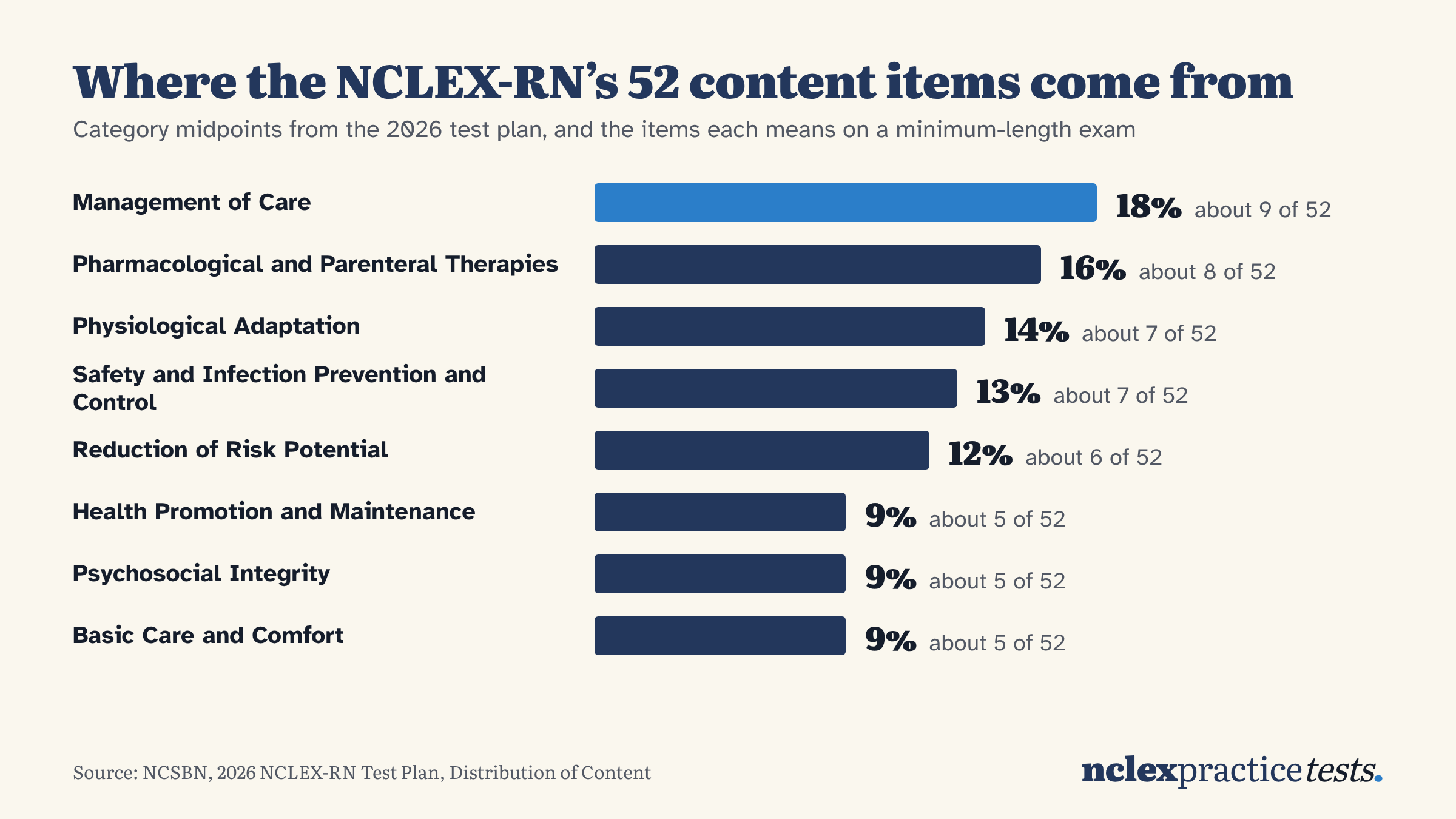
A good NCLEX study plan splits your hours the way the exam splits its questions. The 2026 NCSBN test plan puts 15 to 21% of content items in Management of Care and 6 to 12% in each of the three smallest categories, so this 6-week plan spends about twice as long on the first.
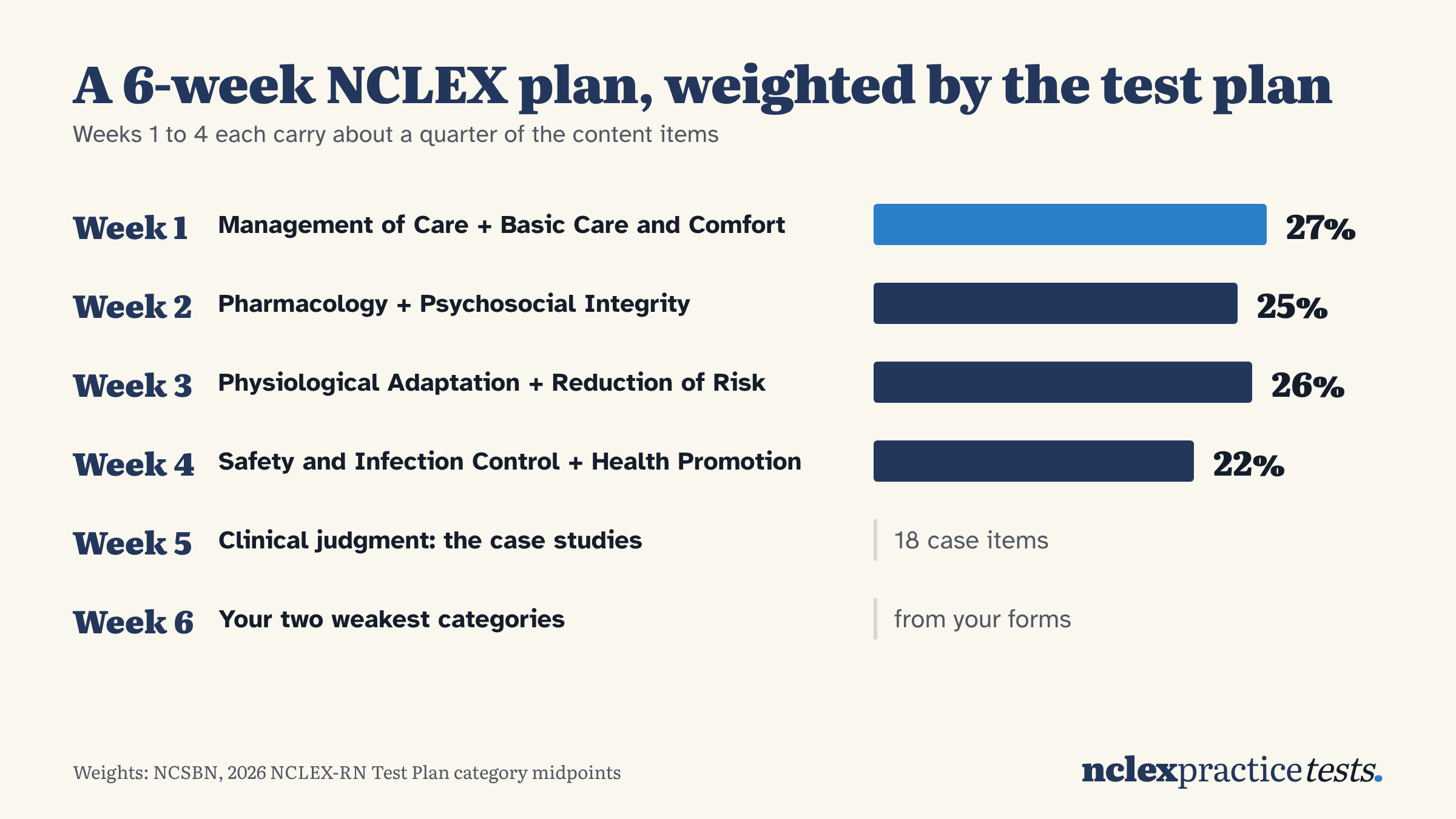
Weeks 1 to 4 cover two of the eight categories each, so every week carries about a quarter of the test plan. Week 5 is clinical judgment and case studies. Week 6 goes back to your weakest categories. Each week includes one of our free 30-question forms.
What the 2026 test plan says you will see
Every NCLEX-RN candidate answers 85 to 150 items in five hours, breaks included. On a minimum-length exam, the 2026 NCLEX-RN Test Plan breaks those 85 items down:
- 52 content items, spread across the eight Client Needs categories in the stated percentages.
- 18 case study items: three cases of six items, counted separately because a case can span any category.
- 15 unscored pretest items, which look like every other item.
The test plan gives each category a range and charts its midpoint. Multiply the midpoint by 52 and you get the number of content items to expect from each category at the minimum length. The same percentages give a fair split of study time.
| Client Needs category | NCSBN range | Midpoint | About this many of 52 items | Hours per 10 hours of review |
|---|---|---|---|---|
| Management of Care | 15 to 21% | 18% | 9 | 1.8 |
| Pharmacological and Parenteral Therapies | 13 to 19% | 16% | 8 | 1.6 |
| Physiological Adaptation | 11 to 17% | 14% | 7 | 1.4 |
| Safety and Infection Prevention and Control | 10 to 16% | 13% | 7 | 1.3 |
| Reduction of Risk Potential | 9 to 15% | 12% | 6 | 1.2 |
| Health Promotion and Maintenance | 6 to 12% | 9% | 5 | 0.9 |
| Psychosocial Integrity | 6 to 12% | 9% | 5 | 0.9 |
| Basic Care and Comfort | 6 to 12% | 9% | 5 | 0.9 |
The item counts are rounded from 9.4, 8.3, 7.3, 6.8, 6.2 and 4.7. They are a guide, not a promise. The test plan says each candidate’s exam may differ by up to 3% in each category, because the test is adaptive and its length varies.
Read the subcategories, not the four headings. "Physiological Integrity" is four separate categories in the test plan. Planning by the eight weights tells you that pharmacology alone outweighs psychosocial care by almost two to one.
The 6-week calendar
Each of the first four weeks pairs a large category with a smaller one, so the weight stays between 22% and 27% a week. Week 1 carries the most weight (27%) and week 4 the least (22%), so the most tested category gets the most repetition before exam day.
| Week | Content focus | Share of the test plan | Practice that week |
|---|---|---|---|
| 1 | Management of Care; Basic Care and Comfort | 27% | Exam 1 in Study mode on day 1, then the prioritization set |
| 2 | Pharmacological and Parenteral Therapies; Psychosocial Integrity | 25% | Pharmacology set, then Exam 2 timed |
| 3 | Physiological Adaptation; Reduction of Risk Potential | 26% | Med-surg set, then Exam 3 timed |
| 4 | Safety and Infection Prevention and Control; Health Promotion and Maintenance | 22% | Exam 4 timed |
| 5 | Clinical judgment: the six steps and the case study format | 18 case items, counted apart | Case study set, then Exam 5 timed |
| 6 | Your two weakest categories from Exams 1 to 5 | Your gaps | Exam 6 timed |
Weeks 1 to 4: content, then questions
Week 1 opens with Exam 1 in Study mode. Read the rationale on every choice, then note which category each miss belongs to. That list is your week 6. The test plan’s list for Management of Care includes prioritizing care by acuity and delegating and supervising care by others, so spend the rest of the week on the prioritization and delegation question set and our walkthrough of how to answer NCLEX prioritization questions.
Week 2 is medications. Start with our NCLEX pharmacology cheat sheet of drug suffixes, checks and antidotes, then work through the NCLEX pharmacology practice questions, which also cover IV therapy and blood products. The blood transfusion reactions guide shows how one topic in this category gets tested from several angles. End with Exam 2 timed.
Week 3 pairs Physiological Adaptation with Reduction of Risk Potential: changes in body systems, lab values, diagnostic tests and the complications that follow procedures. The medical-surgical question set covers both, and Exam 3 closes the week.
Week 4 covers safety, infection prevention and health promotion. The test plan lists infection prevention and isolation, client identification, restraint requirements, preventive care education, and care across ages from newborn to older adult. Review those, then sit Exam 4.
Week 5: clinical judgment
NCSBN measures clinical judgment with the 18 case study items plus about 10% stand-alone items, per the test plan. Each case follows one client through six steps: recognize cues, analyze cues, prioritize hypotheses, generate solutions, take action and evaluate outcomes. Learn the item formats first with NGN question types explained, then read our step-by-step guide to how an NCLEX case study works, and work the eight charted cases on the NCLEX case study practice page. Finish with Exam 5.
Week 6: your weakest two
Go back to the category list you started in week 1, add the misses from Exams 2 to 5, and pick the two categories with the most. Spend most of the week there. Sit Exam 6 timed midweek, so there are still days left to review what it shows you.
How to pace the timed forms
The real exam allows 300 minutes for at most 150 items. That is 2 minutes an item if you reach the maximum, and breaks come out of the same five hours. There is no time limit on any single item, and once you press Next you cannot go back, per the test plan.
Our forms in timed mode use the same pace: 30 items in 60 minutes, with no going back and the rationales held until the end. The results screen breaks your score down by client need, which is exactly the list you need for week 6.
Every one of our six forms uses the same category split: 6 Management of Care items, 5 Pharmacological and Parenteral Therapies, 4 each of Safety, Reduction of Risk Potential and Physiological Adaptation, 3 Health Promotion and Maintenance, and 2 each of Psychosocial Integrity and Basic Care and Comfort. As a share of 30, each falls inside its NCSBN range. One difference: our forms count each case item in a category, while NCSBN counts the 18 case items apart. How we write and tag items is on how questions are written.
A practice score is a map, not a forecast. Use the category breakdown to choose what to study next. It does not predict an NCLEX result, and neither does the number of items you get on exam day.
Do not skip the three 9% categories
Health Promotion and Maintenance, Psychosocial Integrity and Basic Care and Comfort each sit at 6 to 12%. Together that is about 27% of content items, more than Management of Care alone. Many of their items turn on one clear rule, so an hour here can settle several questions. Here are three from our forms.
Health Promotion: the car seat question
This item is on Exam 4.
The parent of a 15-month-old asks when the car seat can be turned to face forward. Which response by the nurse is best?
- A. “Move it to the front passenger seat and turn it forward so you can keep an eye on your child.”
- B. “Keep it rear-facing until your child reaches the highest weight or height your seat allows.”
- C. “You can turn it forward now, because your child is older than 1 year and weighs over 20 lb.”
- D. “Turn it forward once your child’s legs touch the back of the vehicle seat.”
Answer: B. The American Academy of Pediatrics says to keep children rear-facing as long as possible, until they reach the highest weight or height the seat’s maker allows. The 1 year and 20 lb rule in option C is outdated. The AAP also says all children younger than 13 ride in the back seat, which rules out A. Bent legs are not a reason to turn the seat.
Psychosocial Integrity: the direct question
This item is on Exam 1.
A client says, “I am a burden. My family would be better off without me.” What is the best response?
- A. “I won’t tell anyone what you just said.”
- B. “Don’t talk like that. You have so much to live for.”
- C. “Are you thinking about killing yourself?”
- D. “Let’s talk about something happier.”
Answer: C. A statement like this is a cue for suicide risk, and the nurse asks about it directly. The National Institute of Mental Health notes that asking people if they are suicidal does not increase suicidal thoughts or behavior. Secrecy (A) cannot be promised when safety is at risk. Reassurance (B) and a new topic (D) leave the risk unassessed.
Safety: two identifiers
This item is on Exam 6.
The nurse is about to give a scheduled oral medication to an alert client. How should the nurse confirm the client’s identity?
- A. Check the room and bed number against the medication administration record
- B. Ask, “Are you Mr. Silva?” and then check the name on the wristband
- C. Have the client state name and birth date, then check them against the wristband
- D. Compare the name on the door card with the name on the medication record
Answer: C. The Joint Commission’s 2026 National Performance Goals for hospitals require at least two patient identifiers and rule out a room number or physical location as one. Name and birth date, said by the client and checked against the wristband, are a common pair. A bed or door card is no better than a room number. Asking “Are you Mr. Silva?” invites a yes from a client who is drowsy or hard of hearing.
Shorter or longer plans
NCSBN does not recommend a study length, and the right one depends on where your first form leaves you. To compress to 4 weeks, combine weeks 1 and 2 and weeks 3 and 4, and keep the case study and weak-spot weeks. To stretch to 10 weeks, give each of the first four weeks two weeks, with a timed form at the end of each.
Whatever the length, take the free NCLEX tutorial on nclex.com before exam day so the testing screen is familiar. NCSBN makes it available to every candidate. The NCSBN documents behind this plan are listed on sources, and more guides are on the NCLEX study guide page.
This plan is exam preparation, not clinical guidance, and our practice questions are original, not NCSBN items.
Frequently asked questions
How long should I study for the NCLEX?
NCSBN does not set a study length. Six weeks gives each of the eight test plan categories a turn, a week for case studies, and a week for weak spots. Take a practice form first: a low score or a large gap in one category is a reason to plan longer.
Which NCLEX category has the most questions?
Management of Care, at 15 to 21% of the content items in the 2026 NCSBN test plan. Pharmacological and Parenteral Therapies is next at 13 to 19%. On a minimum-length exam that is about 9 and 8 of the 52 content items.
How many questions are on the NCLEX-RN?
Between 85 and 150, in five hours including all breaks. On a minimum-length exam, 52 items follow the category percentages, 18 make up three case studies, and 15 are unscored pretest items, per the 2026 test plan.
Should I study every NCLEX category the same amount?
No. The categories are weighted, so hours should be too. Using the midpoints NCSBN charts in the test plan, every 10 hours of content review splits into about 1.8 hours of Management of Care down to 0.9 hours each for the three smallest categories.
Is 4 weeks enough to study for the NCLEX?
It can be, if you study most days and already score well on practice forms. Compress this plan by combining weeks 1 and 2, and weeks 3 and 4. Keep the case study week and the weak-spot week, because those are where the plan finds your gaps.
Built and maintained by the NCLEX Practice Tests team. Items are original and checked against the published test-plan categories before they go up. Each rationale is reviewed before publish. These are study questions, not official NCSBN items and not medical advice. About this site →